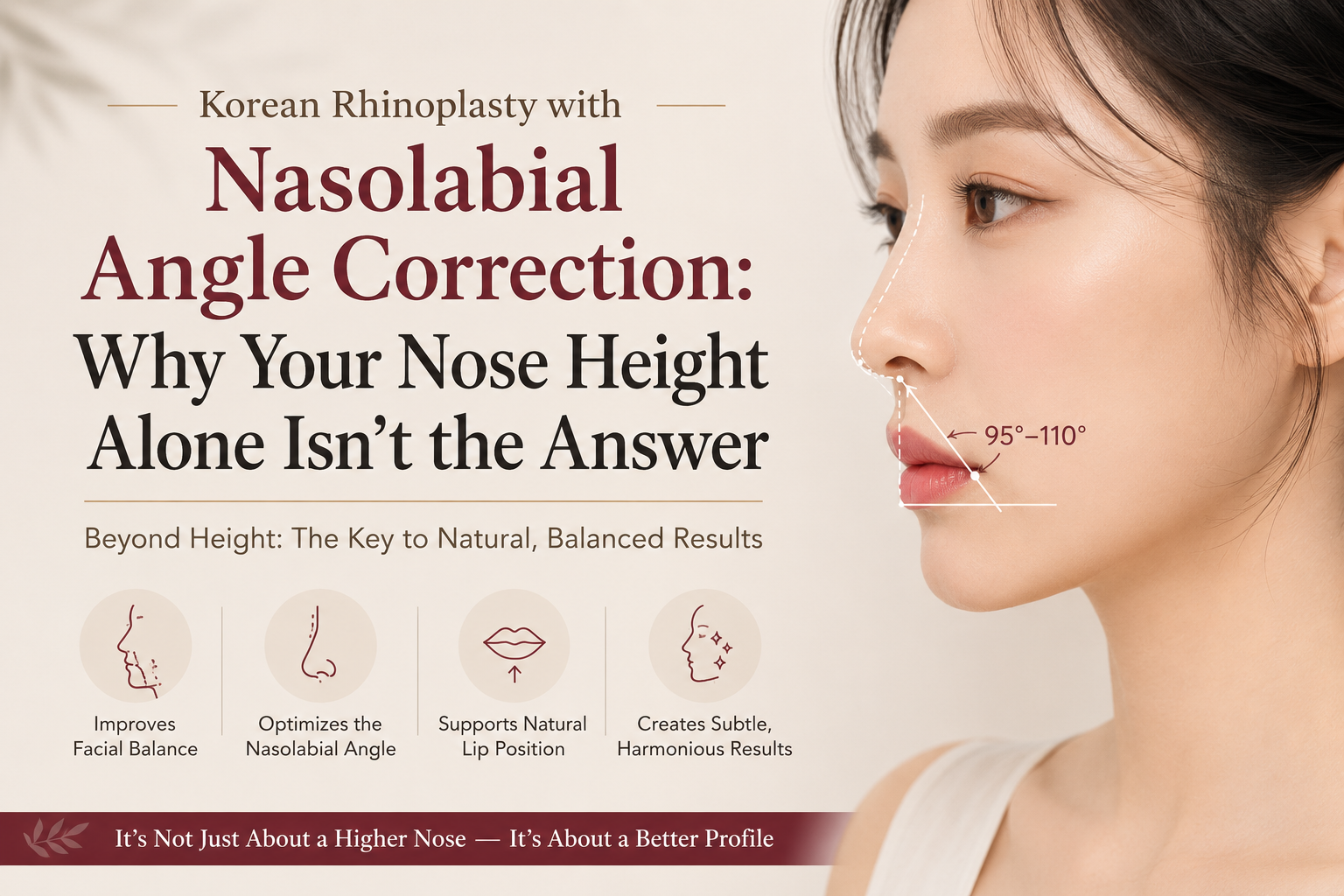
You've done the research. You know what you want.
But there's one thing most rhinoplasty clinics won't tell you until after surgery:
A higher bridge doesn't fix a flat face. It exposes it.
If the angle between your nose and upper lip is wrong, raising the bridge makes that problem more visible — not less. The profile stays flat. The mouth still reads as forward. The result looks like a nose job, not like your face, improved.
The implant isn't the starting point. The angle is.
That's what rhinoplasty at Respect is built around.
What the Nasolabial Angle Is — and Why It Defines Your Profile
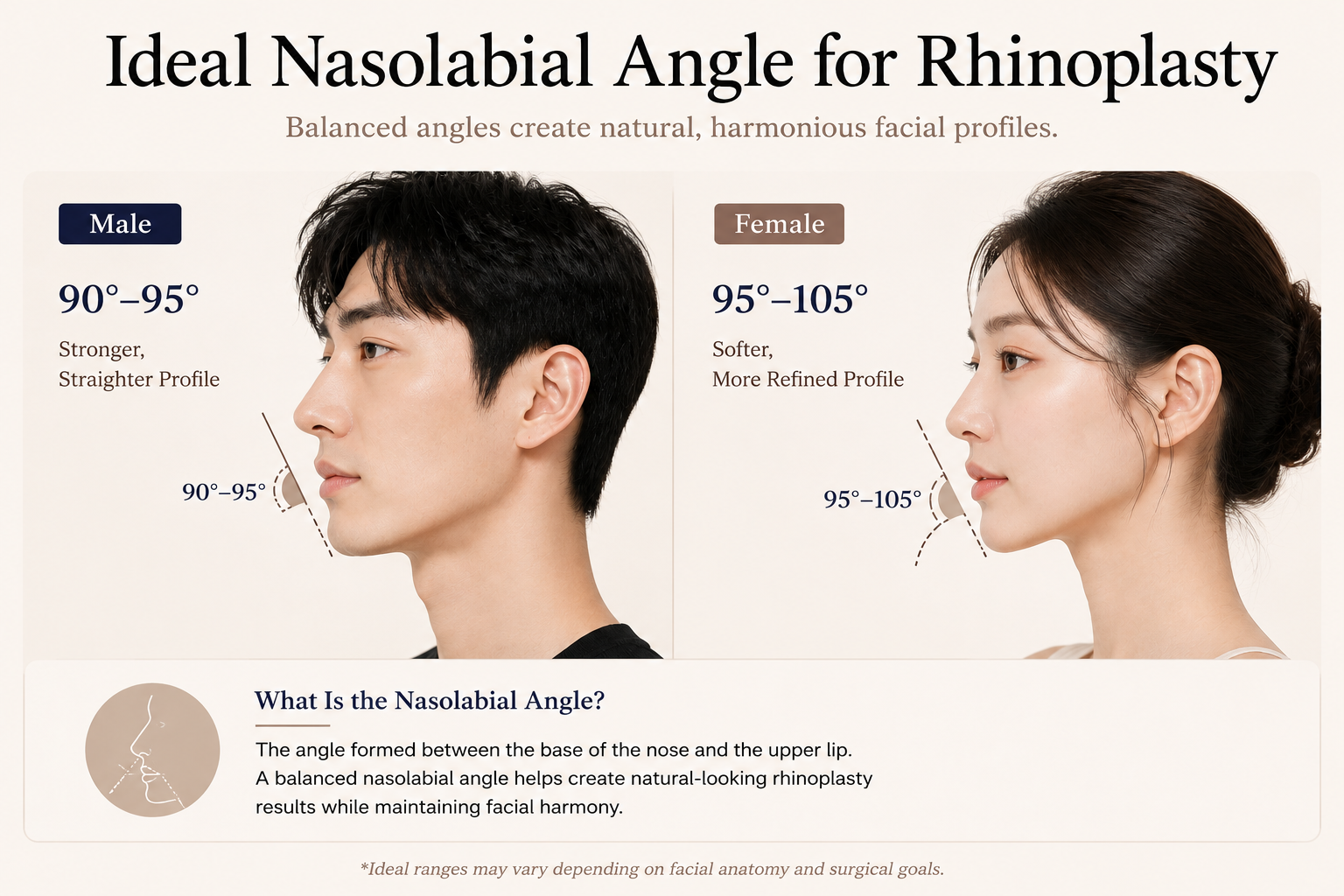
The nasolabial angle is one of the most important measurements in rhinoplasty planning. It refers to the angle formed between the base of the nose and the upper lip, and it plays a major role in determining whether a nose appears natural, refined, masculine, or feminine.
In general, male rhinoplasty patients tend to benefit from a slightly straighter nasolabial angle of 90–95°, while female patients often achieve a softer and more elegant appearance with an angle of 95–105°. However, these ranges are guidelines rather than strict rules. The ideal angle ultimately depends on each patient's facial proportions, lip position, chin projection, and aesthetic goals.
Rather than chasing a specific number, experienced rhinoplasty surgeons focus on creating overall facial harmony. A well-balanced nasolabial angle helps the nose blend naturally with the rest of the face, resulting in a refined appearance that does not look obviously "surgical."
The Respect Approach: Nasolabial Rhinoplasty
Respect Plastic Surgery has developed a specific surgical approach that addresses the nose and nasolabial angle simultaneously.
The goal is not simply to raise the bridge. It is to find the ideal angle between the nose and upper lip — and build the entire nasal structure around that proportion.
The result: a nose that appears more three-dimensional, more upright, and more naturally harmonious with the face — without the tell-tale signs of a nose job.
Dr. Gong Jung Sik, the lead surgeon for this procedure, holds a registered trademark for this specific technique — Certificate of Trademark Registration No. 40-2176407, registered with the Korean Intellectual Property Office on April 1, 2024. It is the only trademarked nasolabial rhinoplasty technique in Korea.
The 4 Measurements That Shape Every Rhinoplasty Plan
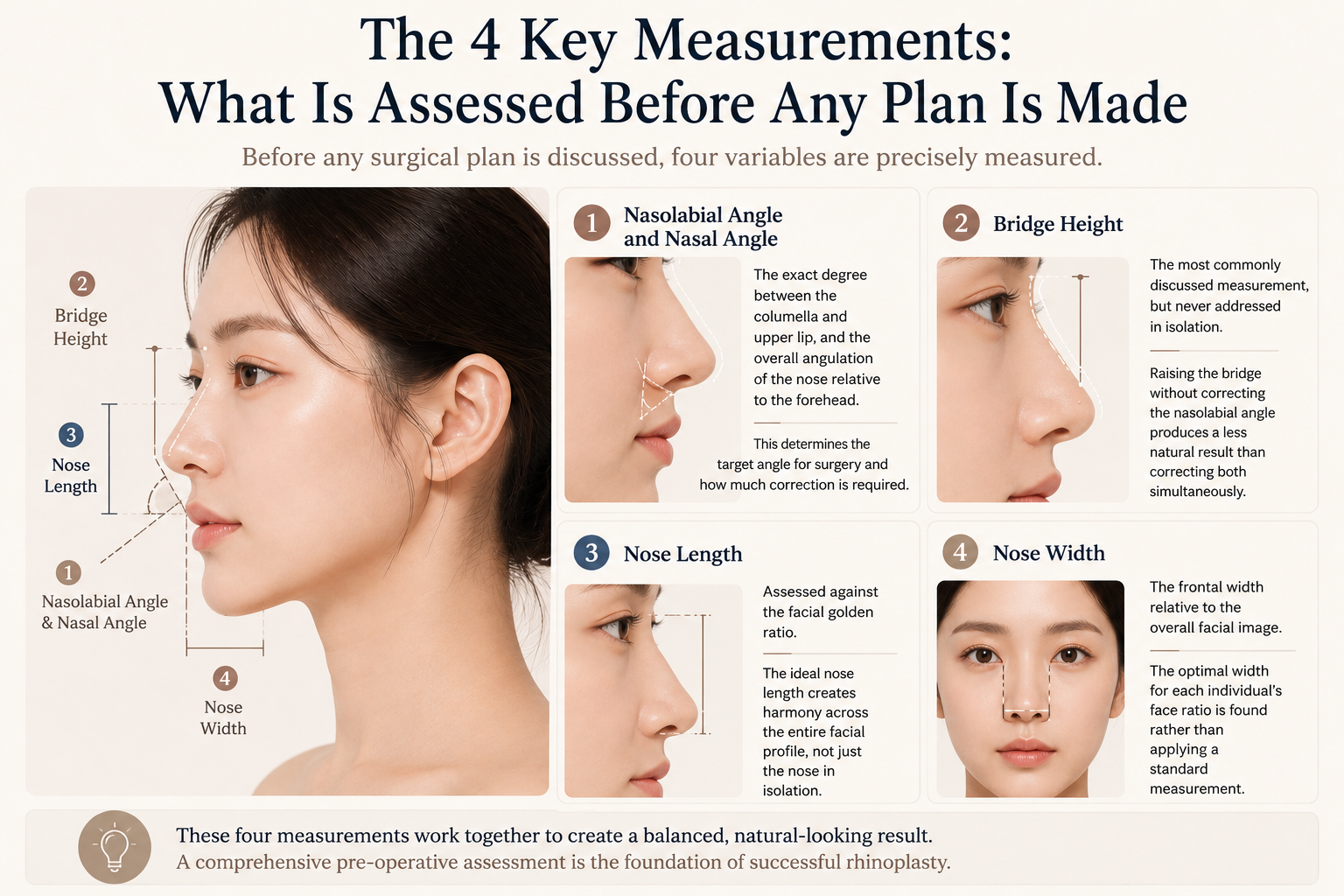
While these measurements are often discussed individually, experienced rhinoplasty surgeons rarely evaluate them in isolation. A nose that appears ideal on paper can still look unnatural if it does not match the surrounding facial structures.
The goal of pre-operative assessment is not to maximize any single measurement, but to understand how each variable interacts with the forehead, lips, chin, and overall facial proportions. This is why two patients with similar noses may receive completely different surgical recommendations.
At Respect Plastic Surgery, rhinoplasty planning begins with a comprehensive facial analysis rather than a standardized template. The most successful results are achieved when the nose is designed as part of the face as a whole, creating balance, harmony, and long-term naturalness rather than simply increasing height or projection.
4 Changes Patients Notice After Nasolabial Angle Correction
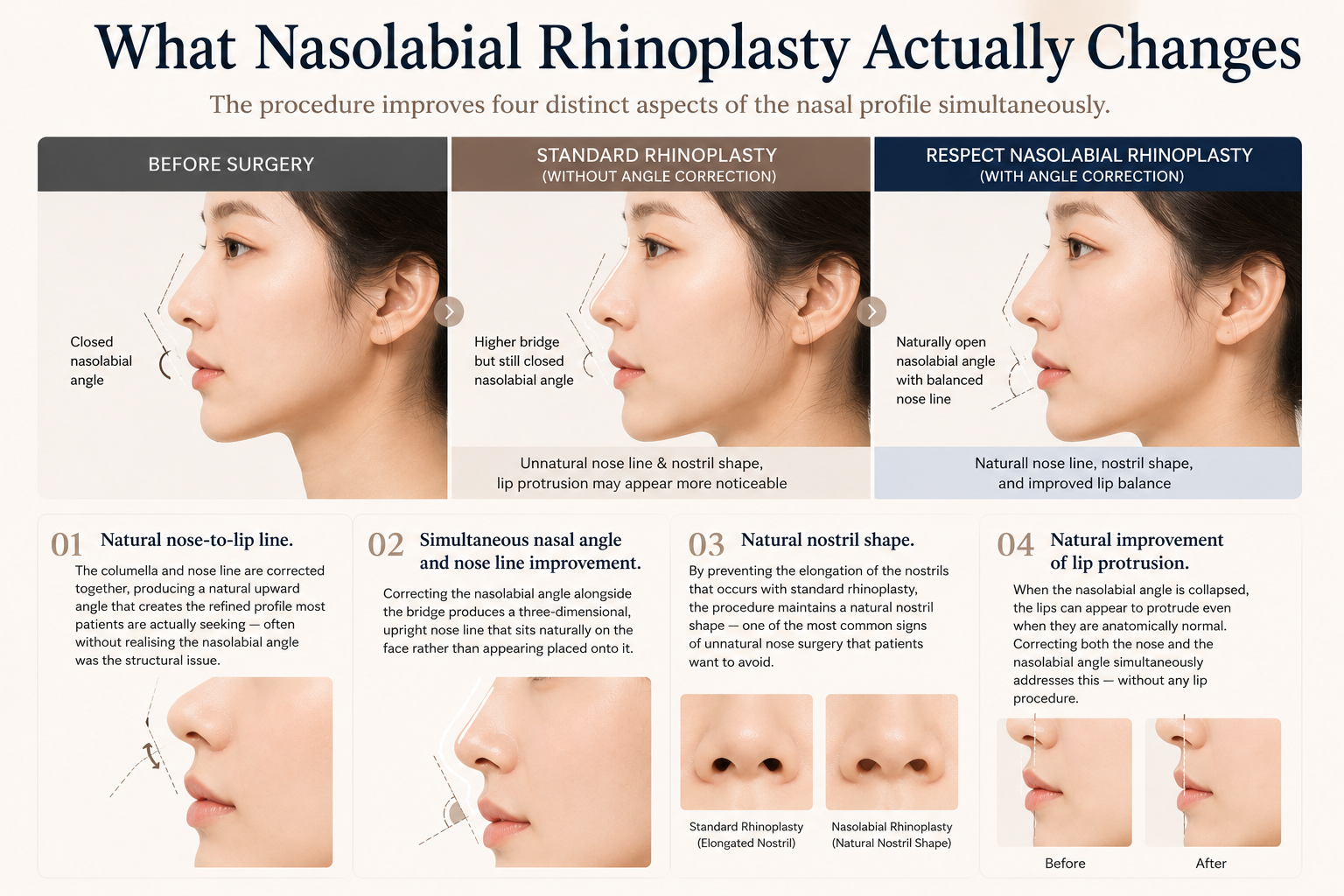
Many patients initially focus on bridge height when considering rhinoplasty. However, some of the most noticeable improvements often come from changes that are less obvious at first glance.
When the nasolabial angle is properly addressed, the nose tends to appear more balanced within the overall facial profile. The transition between the nose, upper lip, and nostril area becomes smoother, helping the result look naturally harmonious rather than surgically altered.
This is why patients often describe the outcome as looking "refreshed" or "more refined" rather than simply having a higher nose. The goal is not to create a dramatic change in a single feature, but to improve how the entire profile works together.
Korean Rhinoplasty with Nasolabial Angle Correction — Before & After
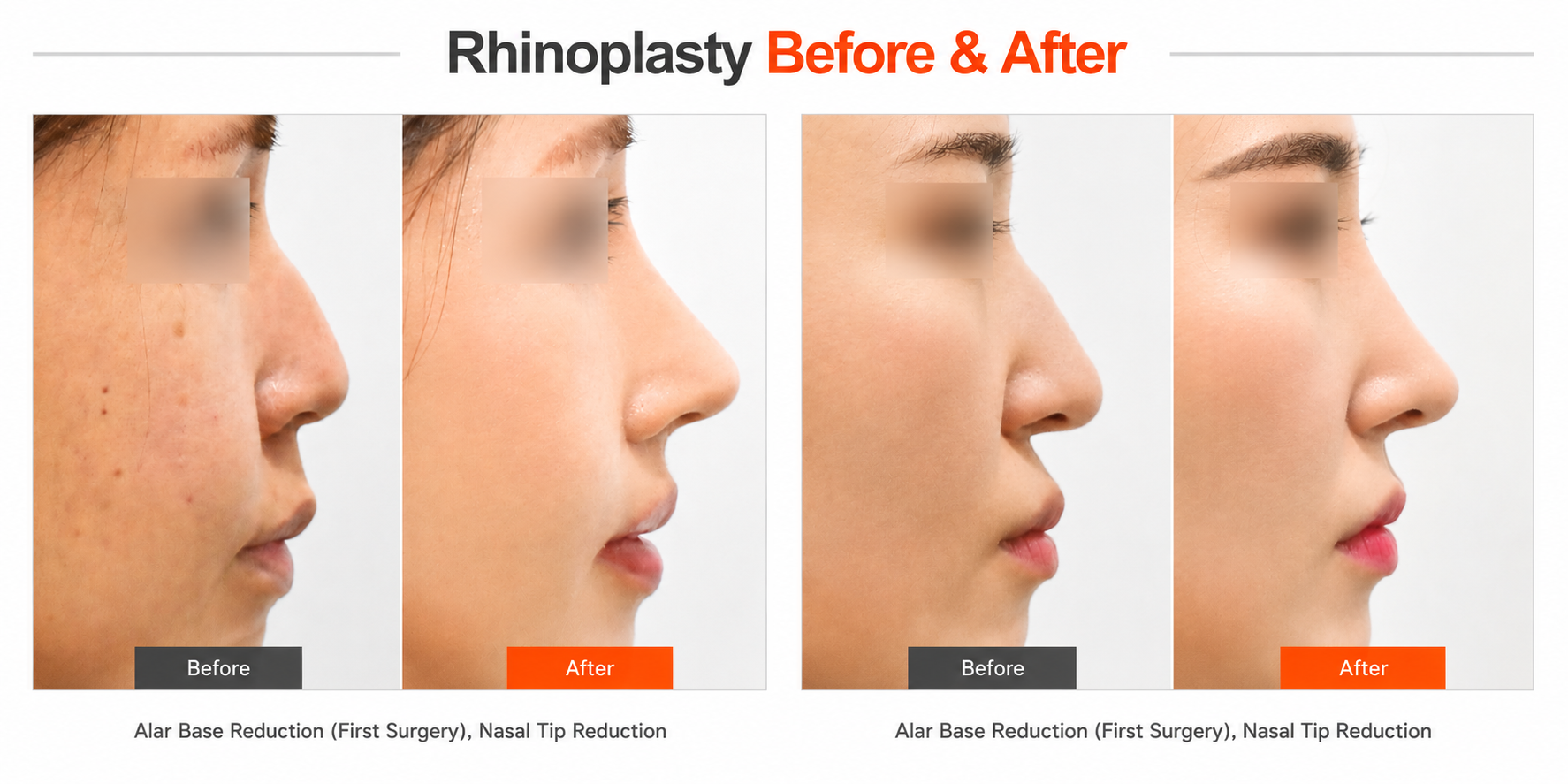
Who Is This Procedure Right For?
Nasolabial rhinoplasty at Respect is specifically designed for patients who:
- Have a low bridge and small nasolabial angle where the nose appears sunken
- Have a low bridge combined with underdeveloped upper jaw, causing the mouth to appear to protrude
- Have a flat mid-face appearance including the nose area
- Want to improve both the nasolabial angle and nose line simultaneously
- Want to naturally add three-dimensionality to the face overall
If you have ever pushed your nose upward with your finger and felt that the profile immediately looked more balanced — the nasolabial angle is likely the structural issue.
Why the Same Philtrum Procedure Doesn't Work for Everyone
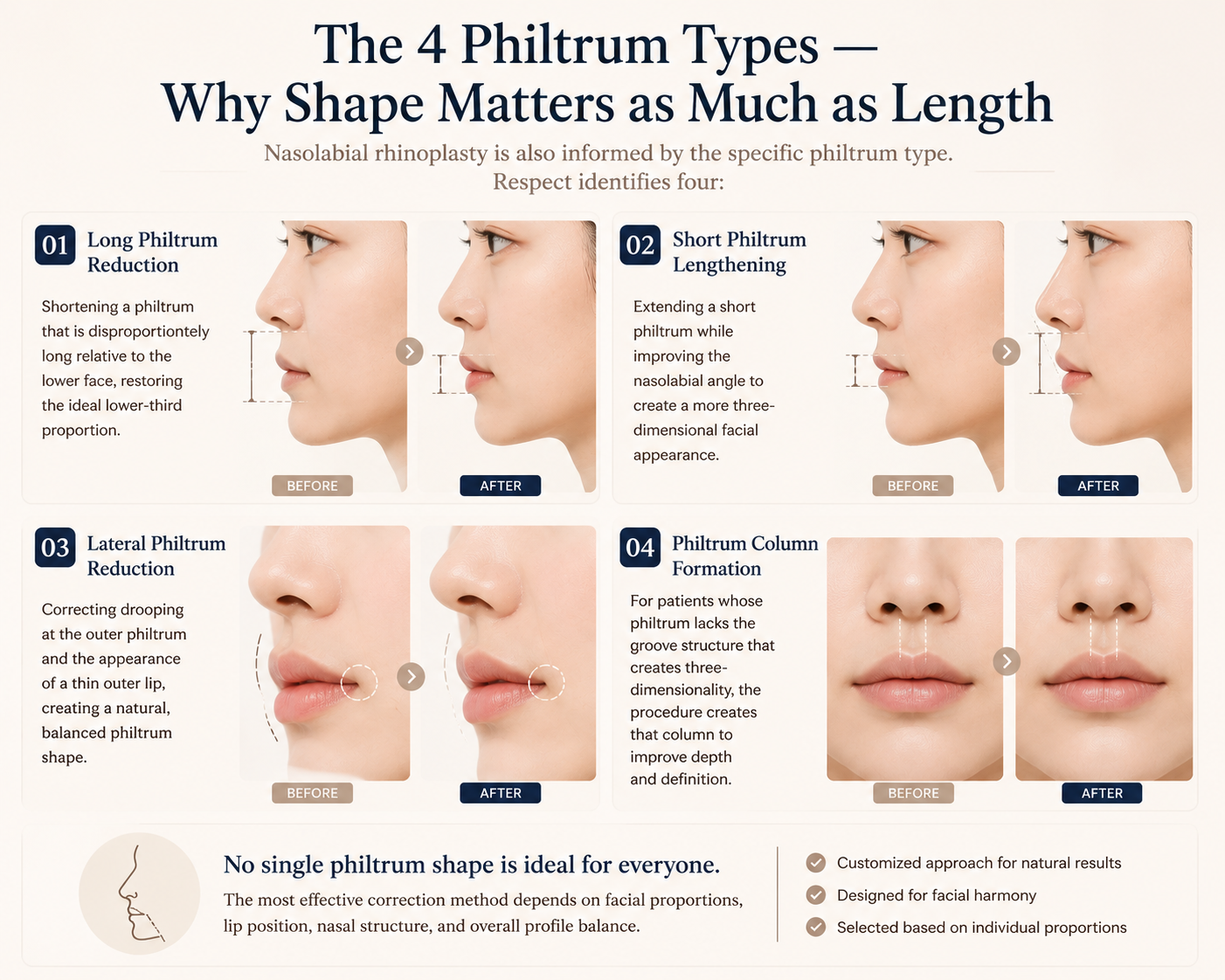
Many patients assume that a philtrum concern can be solved by simply shortening or lengthening the area between the nose and upper lip. In reality, philtrum aesthetics are influenced by multiple factors, including facial proportions, lip shape, nasal structure, and the three-dimensional relationship between surrounding features.
This is why the same procedure does not produce ideal results for every patient. A correction that improves one person's facial balance may create disproportion in another. The goal is not to fit every patient into a single standard, but to identify the specific structural characteristics that are affecting facial harmony.
At Respect Plastic Surgery, philtrum correction is planned as part of an overall facial analysis. By selecting the appropriate approach for each philtrum type, surgeons can create results that look balanced, natural, and consistent with the patient's existing facial features rather than obviously altered.
The Effects: What Changes After Surgery
✓ Natural nose-to-lip line — columella and nose angle corrected together
✓ Improved mid-face three-dimensionality — the entire mid-face gains depth and structure
✓ Natural lip protrusion correction — without any lip procedure
✓ Overall facial impression correction — the face reads as more refined, less flat
The Procedure: What to Expect
Surgery time: 1.5–2 hours
Anaesthesia: General (sleep anaesthesia)
Hospitalisation: Not required
Suture removal: Around 7 days post-op
Internal treatment: 2 sessions
Recovery: 7–10 days
The procedure is performed with precision-planned incisions. The surgical plan is built from the exact measurements taken at consultation — nasolabial angle degree, bridge height, nose length, and width — confirmed before any incision is made.
The Surgeon Behind the Procedure
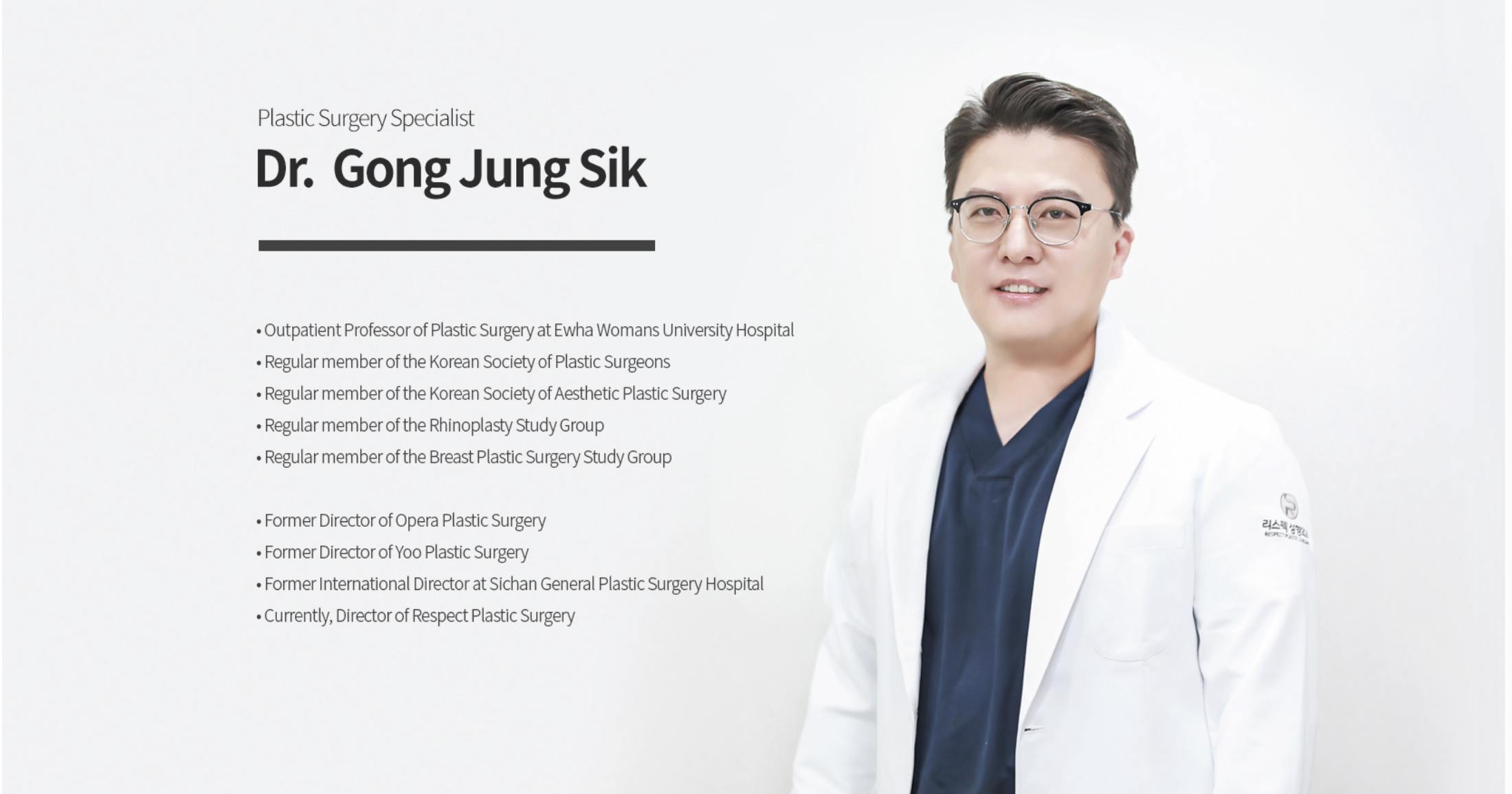
Dr. Gong Jung Sik is the lead nasolabial rhinoplasty surgeon at Respect and the registered trademark holder for this specific technique — the only trademarked nasolabial rhinoplasty approach in Korea.
Academic and professional background:
- Outpatient Professor of Plastic Surgery, Ewha Womans University Hospital
- Regular member, Korean Society of Plastic Surgeons
- Regular member, Korean Society of Aesthetic Plastic Surgery
- Regular member, Rhinoplasty Study Group
- Regular member, Breast Plastic Surgery Study Group
- Former Director, Opera Plastic Surgery
- Former Director, Yoo Plastic Surgery
- Former International Director, Sichan General Plastic Surgery Hospital
- Currently Director, Respect Plastic Surgery
Registered trademark:
- Certificate of Trademark Registration No. 40-2176407
- "Gong Jung Sik's Nasolabial Rhinoplasty"
- Korean Intellectual Property Office — registered April 1, 2024
Academic activities:
- Speaker, Endoscopic Breast Augmentation Forum — Chengdu, China
- Former judge, All-China Breast Plastic Surgery Conference
- Presenter, All-China Breast Aesthetic Conference — Beijing
- Presenter, Central and Western China Aesthetic Plastic Surgery Conference — Chengdu
Media coverage:
- Lead surgeon and committee member, "Beautiful You" plastic surgery programs — multiple national television appearances
His guiding principle: "My ultimate rule — leaving no trace."
The Rhinoplasty Study Group membership reflects active, ongoing engagement with outcomes data and technique development in nasal surgery specifically. His international directorship at Sichan General Plastic Surgery Hospital — and his conference presence across Beijing and Chengdu — reflects exposure to diverse anatomical cases and peer-level clinical debate that purely domestic practice does not provide.
A surgeon who has presented and judged at international conferences, holds a registered trademark for a specific surgical technique, and maintains an active academic study group membership is not practicing from a static knowledge base. The technique evolves. The outcomes data is continuously reviewed.
That is what "leaving no trace" actually requires.
Frequently Asked Questions
Q. Can the duck-lip or protruding mouth appearance be improved with nasolabial rhinoplasty?
A. Yes. A collapsed nasolabial angle is frequently the structural cause of a lip that appears to protrude. When the angle is too small, the nose appears sunken and the mouth reads as forward. Correcting the nasolabial angle simultaneously with the bridge often resolves the appearance of lip protrusion — without any lip procedure.
Q. Is nasolabial rhinoplasty only about the nasolabial angle?
A. No. The procedure addresses the nose and nasolabial angle together as a system. It considers the relationship between bridge height, nose length, nostril shape, and the angle between the nose and upper lip — producing a result that is harmonious across the entire mid-face rather than addressing a single measurement in isolation.
Q. How is this different from standard rhinoplasty?
A. Standard rhinoplasty typically focuses on bridge height and tip shape. Nasolabial rhinoplasty at Respect simultaneously corrects the nasolabial angle — the relationship between the nose and the upper lip. This produces a more three-dimensional result for patients whose core issue is mid-face flatness or a collapsed nose-to-lip line, rather than simply low bridge height.
Q. How long does recovery take?
A. Visible swelling resolves significantly within 7–10 days. Most patients are comfortable returning to normal activity within one to two weeks. Final result, including full settling of the nasal tip and nasolabial angle, takes 3–6 months.
Q. How much does nasolabial rhinoplasty cost in Korea?
A. Pricing is confirmed after consultation based on the degree of nasolabial angle correction required and whether additional procedures are combined. International patients receive a preliminary cost estimate through the online consultation process before traveling to Seoul.
Q. Can this be combined with other procedures?
A. Yes. Nasolabial rhinoplasty is commonly combined with upper lip lift, double eyelid surgery, or chin augmentation as part of a comprehensive facial proportion approach. The sequence and combination are planned individually.
Coming to Korea? Here's What to Expect.
Choosing a rhinoplasty clinic from abroad requires a different kind of trust. You can't walk in and feel the space. You can't meet Dr. Gong before committing to travel.
Respect was built with this in mind.
Step 1 — Online photo consultation.
Send front, side, and 45-degree photos. Dr. Gong reviews your nasolabial angle, bridge height, and facial proportions — and provides a preliminary assessment before you travel. You receive a real medical opinion before committing to anything.
Step 2 — Arrive in Seoul.
Airport pickup available. Accommodation recommendations near the clinic provided. A point of contact from the moment you land.
Step 3 — In-person consultation.
Precise measurements taken. Surgical plan confirmed. You meet Dr. Gong directly, ask every question you need to ask. Nothing is rushed.
Step 4 — Surgery.
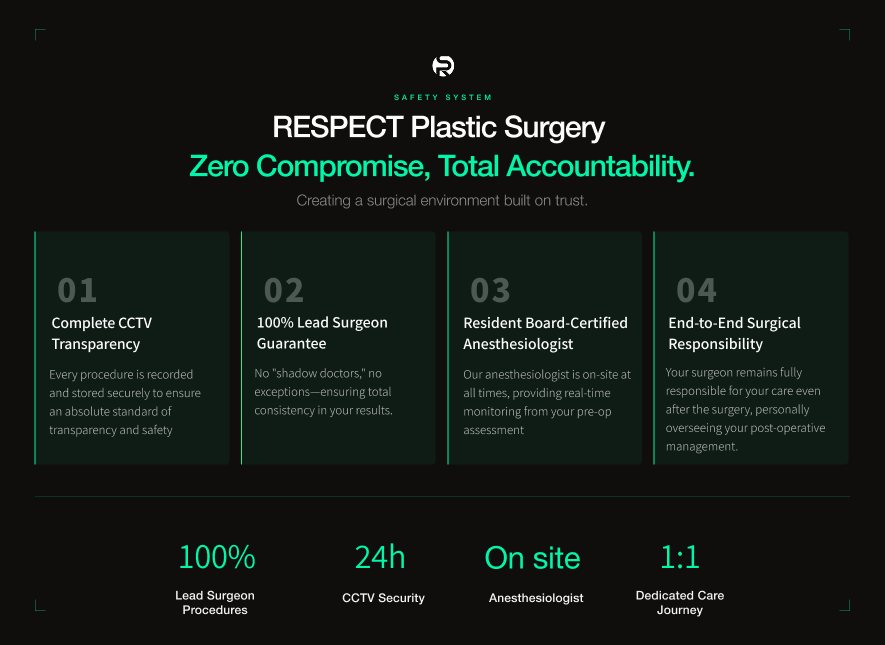
Performed by Dr. Gong. A dedicated board-certified anesthesiologist trained at Seoul National University is present throughout — not on-call, on-site.
Step 5 — Recovery in Seoul.
7–10 days recommended before flying. The clinical team monitors your recovery throughout.
Step 6 — Remote follow-up after you're home.
Post-operative care continues online — the same surgeon, the same standard of care, from wherever you are.
The technique is trademarked. The credentials are documented. The process is clear.
You already know something isn't quite right. That's why you're still researching.
The nose you're looking for isn't just higher. It's more balanced, more three-dimensional, more yours — a face that looks refined without looking altered.
That result starts with one measurement most clinics skip entirely.
At Respect Plastic Surgery, the consultation begins with your nasolabial angle — not an implant catalogue.
Click here to schedule a consultation.
English consultations are available for international patients.

 Google Maps