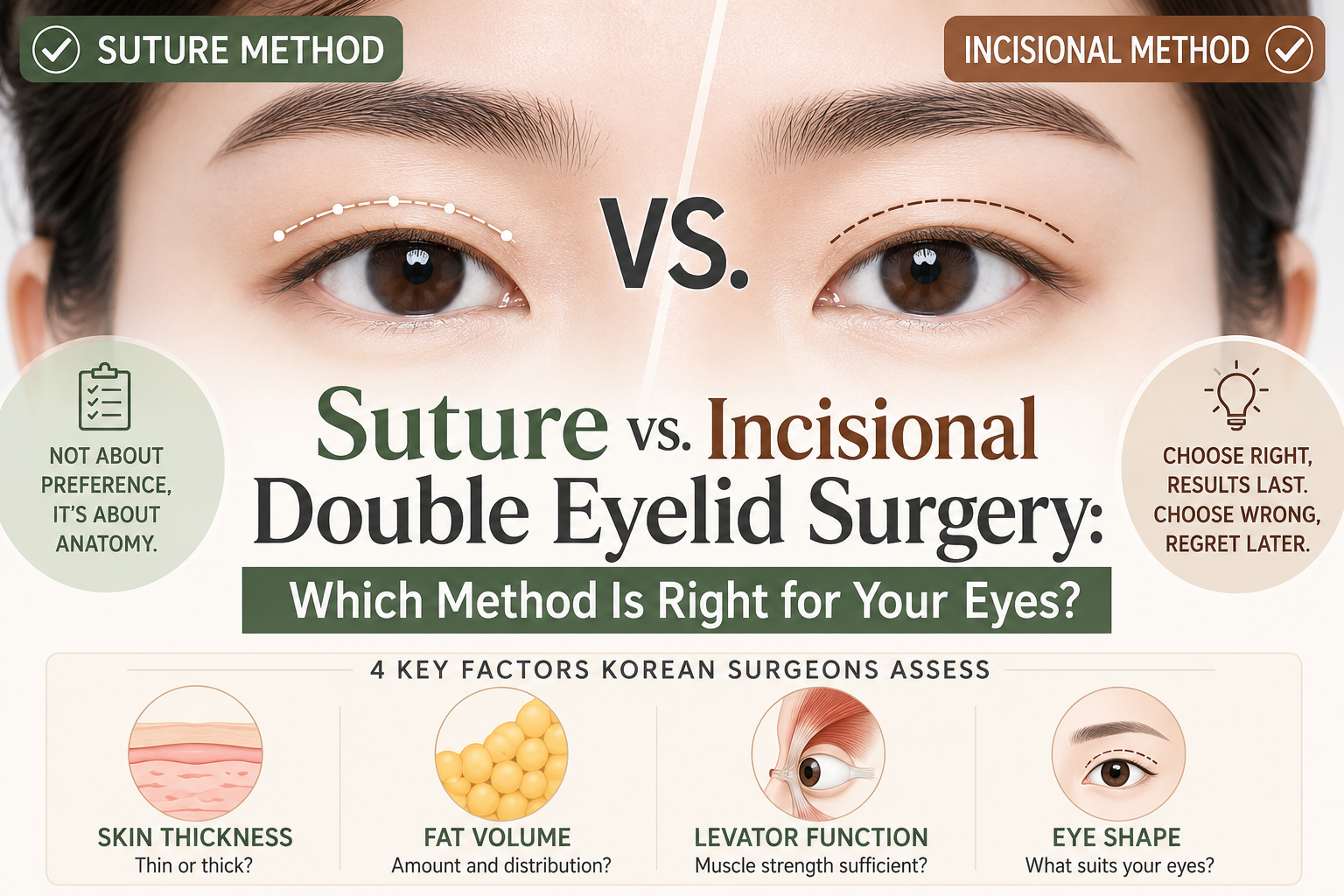
"Should I get suture or incisional double eyelid surgery?"
It's the most common question in any double eyelid consultation. Most people arrive having already decided — after hours of research, watching videos, reading forums. They have a preference before they've even sat down.
But the method shouldn't come first. Your eyes should.
The same suture technique that creates a beautiful, natural crease on one person is the worst possible choice for another. The same is true for incisional. Before any method is discussed, four specific conditions of your eyes need to be assessed — and those conditions determine everything: the crease height, the shape, and the surgical approach.
This guide covers exactly what a Korean plastic surgeon evaluates before recommending either method — and why getting that assessment right is the difference between a result that looks natural and one that doesn't.
What Is Double Eyelid Surgery — and Why Does Korea Do It Differently?
Double eyelid surgery creates a defined crease in the upper eyelid. In people without a natural crease — common in East Asian anatomy — the upper eyelid appears as a single smooth surface. The procedure forms a fold that makes the eye appear larger, brighter, and more defined.
Korea performs more double eyelid surgeries per capita than anywhere else in the world. That volume — tens of thousands of procedures per year — has produced a level of design precision and anatomical understanding of Asian eyelid structure that simply doesn't exist at the same depth elsewhere.
The Korean standard for a successful result: the crease looks as though it was always naturally there. Not "pretty surgery." Not "obvious surgery." Eyes that are clearly better — and completely undetectable.
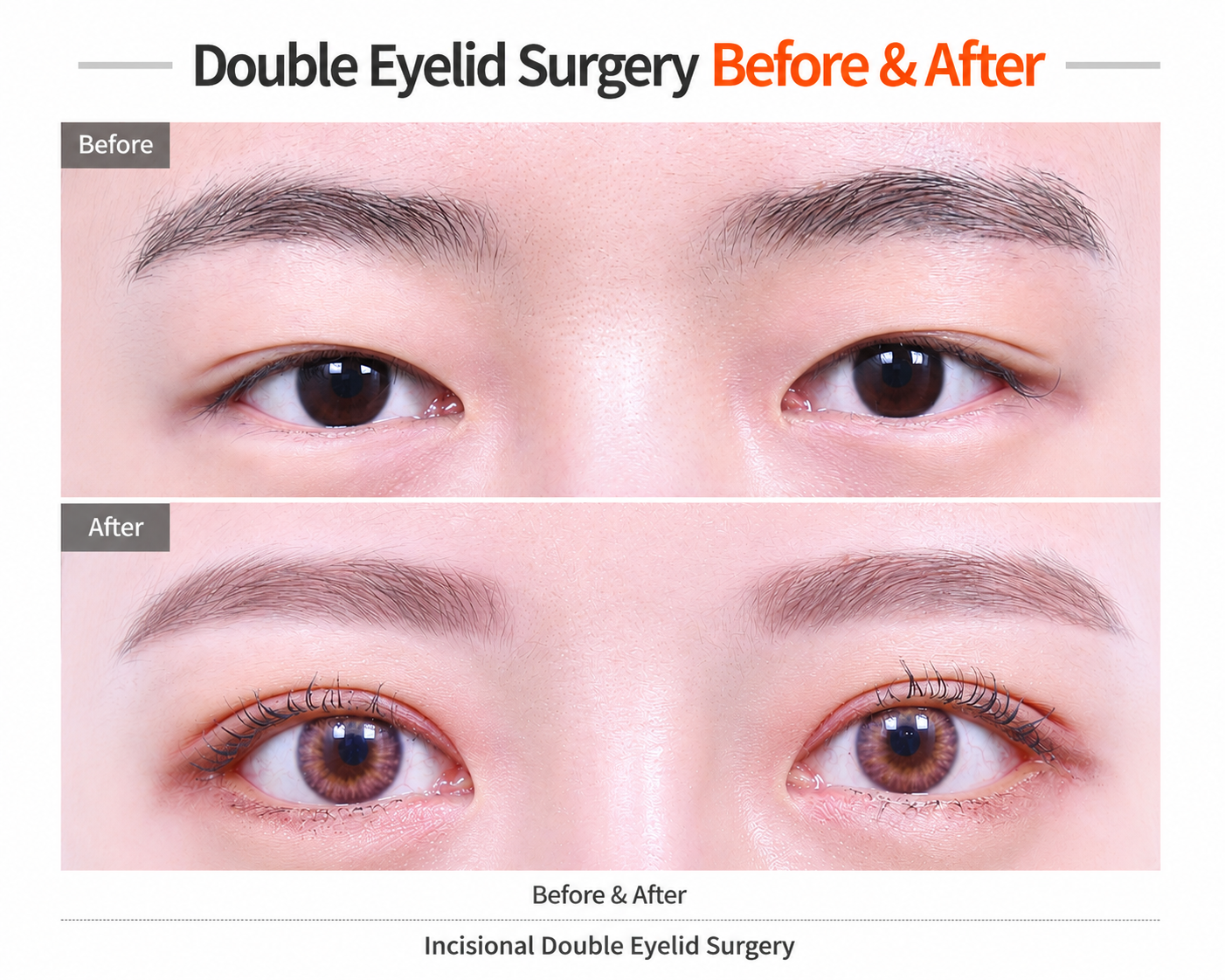
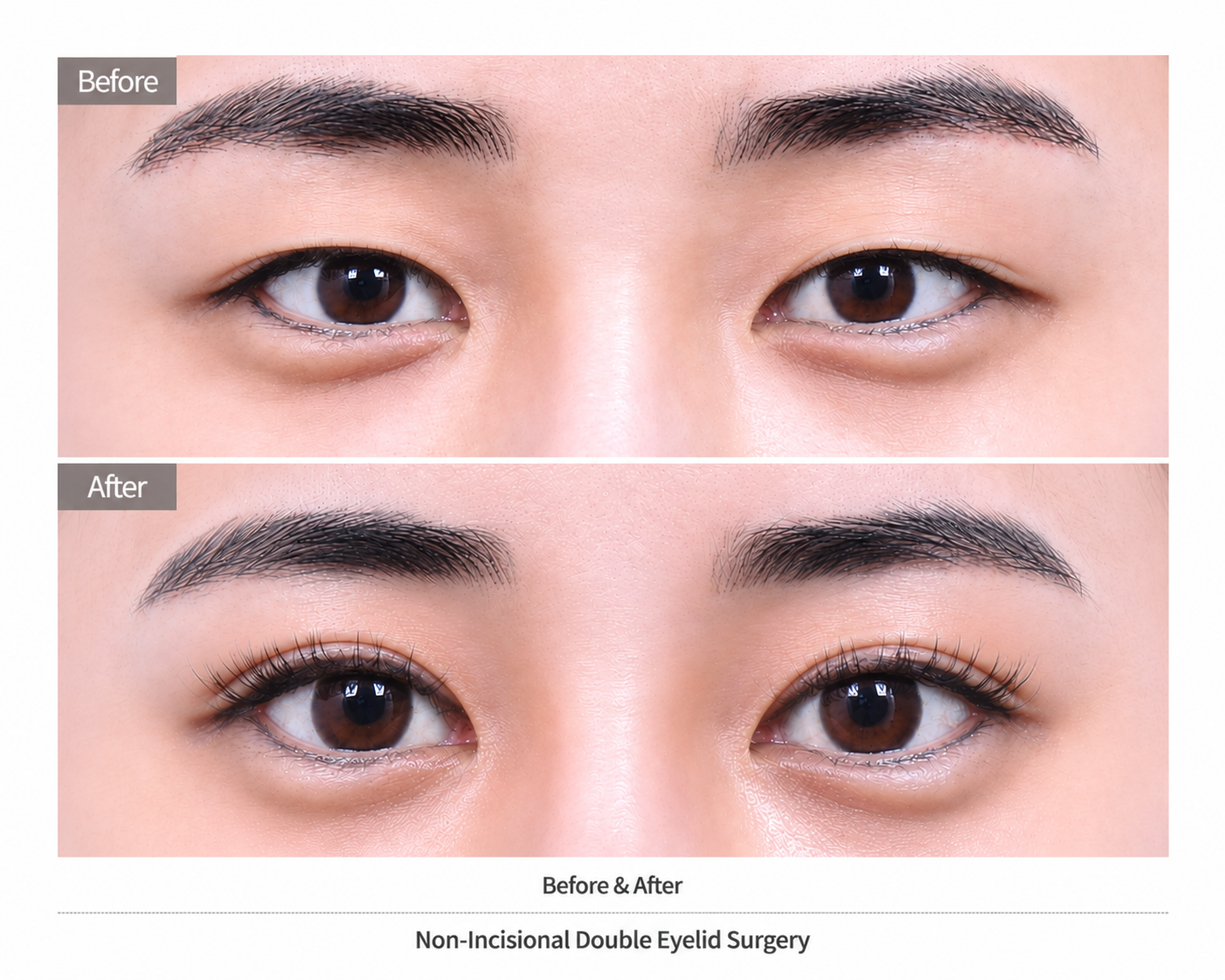
The Four Eye Conditions That Determine Everything
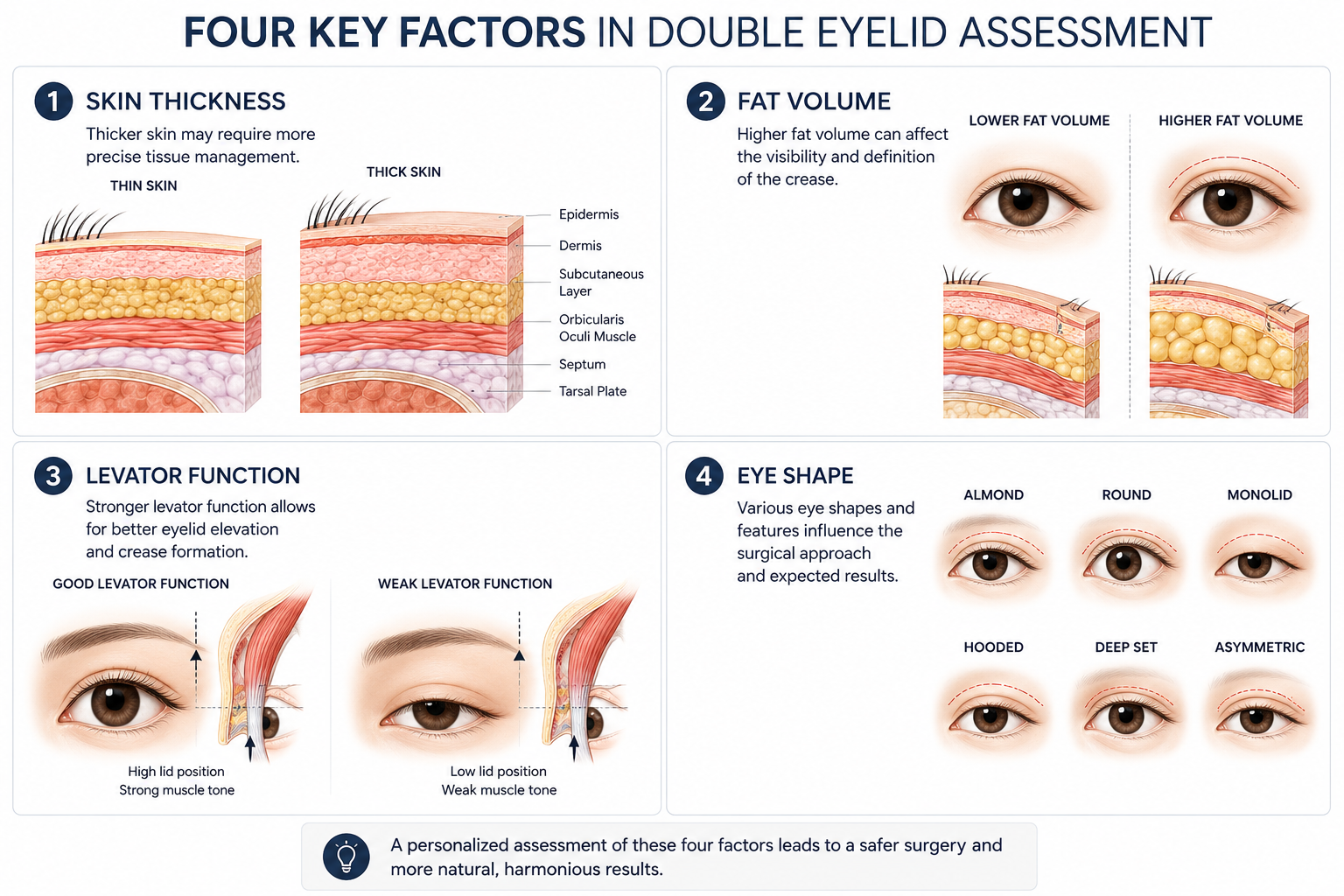
Before any crease design or method discussion, four factors are assessed. These conditions determine the crease height, fold shape, and whether suture or incisional is appropriate.
1. Eyelid Skin Thickness and Elasticity
Thin, elastic eyelid skin responds beautifully to the suture method — it holds the crease cleanly and produces a refined, natural fold. Thicker skin, or skin that has lost elasticity, can cause puffiness at the same crease height, or cause a suture crease to fade over time. These eyes need the structural stability of the incisional approach.
2. Upper Eyelid Fat Volume
When there is significant upper eyelid fat, the crease line gets buried and appears indistinct. The suture method cannot adequately address fat. For fattier eyelids, the incisional approach — removing an appropriate amount of fat before securing the crease — produces a dramatically cleaner, more lasting result.
3. Levator Muscle Strength
The levator muscle controls how wide the eye opens. When levator function is weak — a condition called ptosis — creating a double eyelid without simultaneously addressing this produces eyes that still look tired, or causes the patient to unconsciously raise their forehead to open their eyes, deepening forehead wrinkles over time. Ptosis correction must be considered alongside the crease design, and typically requires the incisional approach.
4. Natural Eye Shape
Horizontal eye length, the presence of an epicanthal fold at the inner corner, outer corner angle, brow-to-lid distance — all of these influence the ideal crease height and shape. Overall facial proportions and pupil size are also factored in. Two people asking for "the same crease" may need completely different designs.
Suture vs. Incisional: The Real Differences
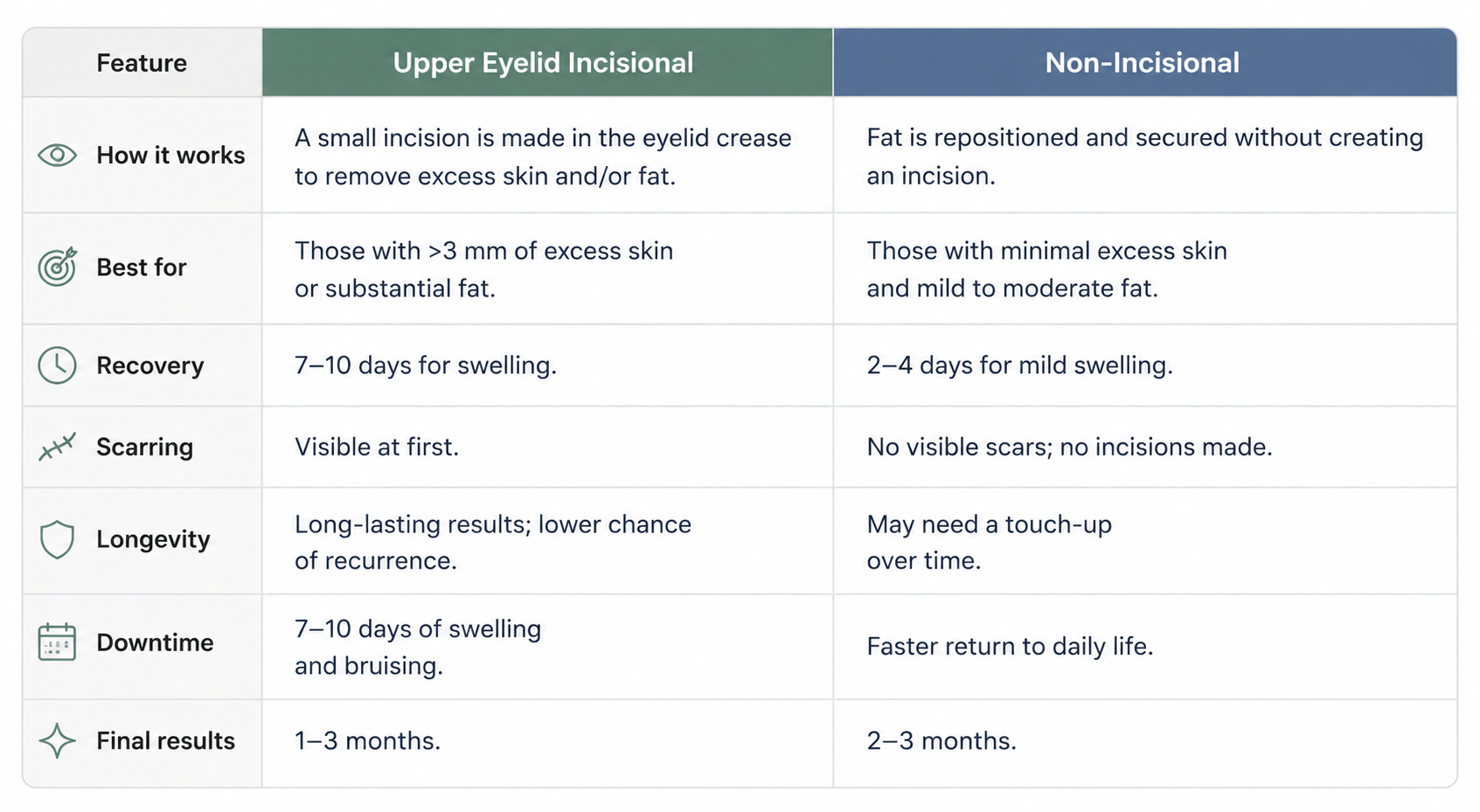
The clearest principle: good surgery achieves the most natural result with the least intervention necessary. That judgment comes from the eye conditions — not from personal preference, and not from which method is currently trending.
Who Is Each Method Right For?
Suture may be right if:
- Eyelid skin is thin and elastic
- Minimal upper eyelid fat
- Levator muscle function is adequate
- You want a subtle, natural crease with shorter recovery
- No previous eyelid surgery history
Incisional may be right if:
- Eyelid skin is thick, heavy, or has lost elasticity
- Noticeable upper eyelid puffiness from excess fat
- Weak levator function (ptosis)
- You want a structurally permanent crease
- Previous suture that faded or loosened
Many patients fall somewhere in between — thin skin but significant fat, good elasticity but mild ptosis. These combination cases are exactly why in-person assessment matters. Self-diagnosis can point you in a direction. The final decision needs a surgeon who has seen your eyes.
What Happens When the Wrong Method Is Chosen
This is what most online guides skip over. Getting the method wrong doesn't just produce a suboptimal result — it can produce an outcome that requires revision surgery to correct.
Crease set too high: Excessive skin folding creates a puffy, visibly unnatural appearance above the eyelid. The eyes can appear smaller rather than larger — the opposite of the intended effect.
Suture on the wrong eyes: Fatty eyelids treated with suture-only fixation frequently lose the crease within 1–3 years. The crease fades, becomes uneven, or disappears entirely — leading to revision surgery that is more complex than if incisional had been chosen from the start.
Levator muscle overlooked: Creating a double eyelid without addressing ptosis results in eyes that still look tired regardless of the crease. The patient compensates by raising their forehead, which accelerates forehead wrinkles. The crease may look fine in isolation, but the overall eye appearance hasn't improved.
Asymmetry not accounted for: Most people's eyes are not perfectly symmetrical. If natural asymmetry isn't carefully measured and incorporated into the design, the result can amplify the imbalance rather than correct it.
This is why the consultation and design phase takes longer than the surgery itself. The question isn't which crease looks pretty in a reference photo. It's which crease is right for these eyes.
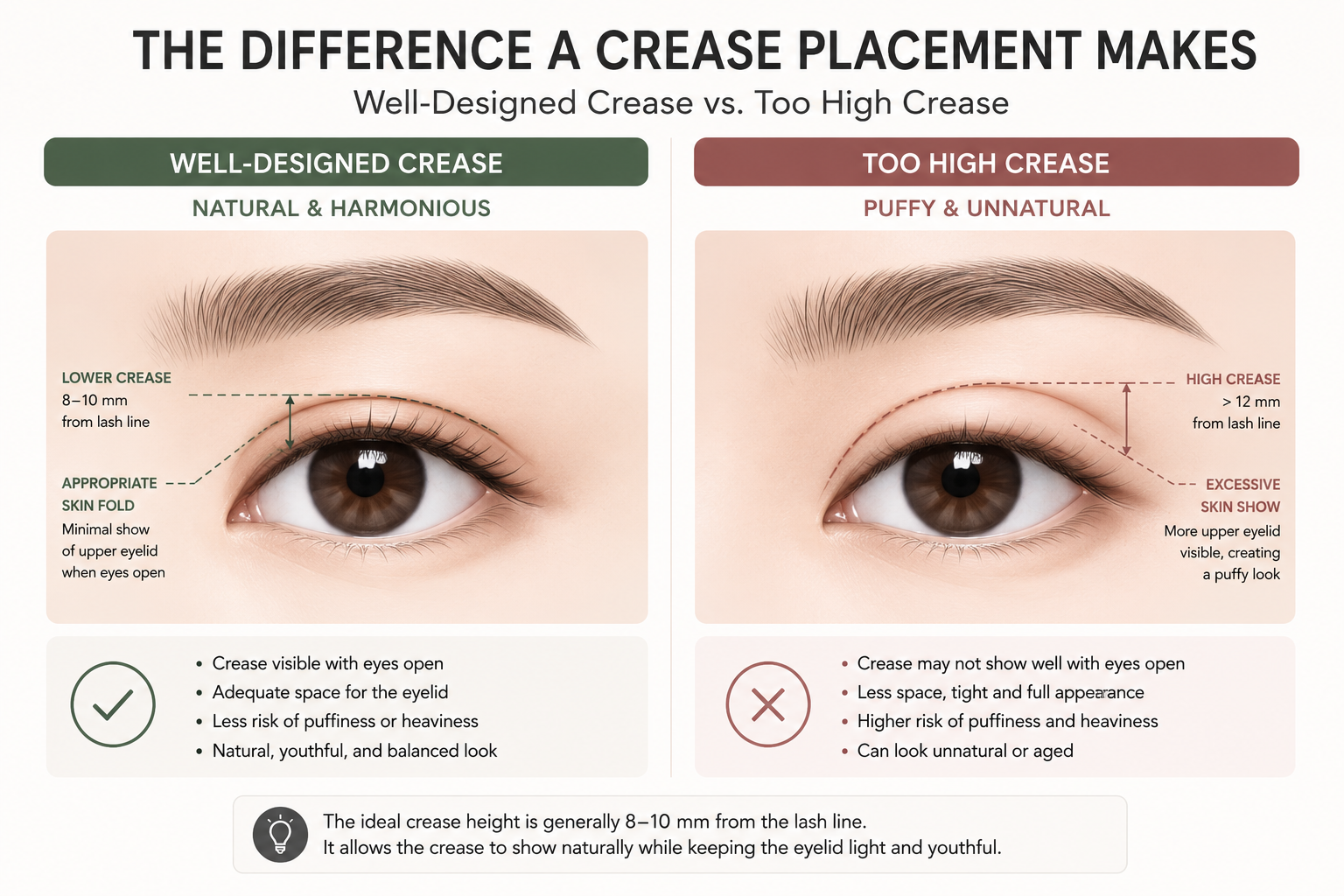
How Crease Design Works: Why 1mm Changes Everything
Once the method is determined, crease design begins. Three parameters are fine-tuned at the millimetre level.
Crease height (typically 5–7mm): A 5mm crease produces a subtle inner fold. 6mm produces a defined natural line — the most commonly targeted result. 7mm produces a higher, more dramatic crease that reads as visibly surgical on many Asian eyes.
Starting point: Where the crease begins at the inner corner determines the character of the eye. Starting from the inner corner produces a defined, bright impression. Starting from mid-eyelid creates a softer, more natural look.
Tail angle: The angle at which the crease extends toward the outer corner. Slightly upward produces a refreshed, open appearance. Horizontal produces a softer, more relaxed look.
All three parameters are confirmed with the patient sitting upright — not lying down — because gravity changes how the eyelid falls. The design phase alone can take longer than the surgical procedure.
Recovery: What to Expect
Suture recovery
- Days 1–5: Swelling, mild bruising
- Day 5–7: Most patients return to daily activity
- Month 1–3: Crease gradually settles into final position
Incisional recovery
- Days 1–7: Noticeable swelling, some bruising
- Day 5–7: Suture removal
- Week 2–3: Significant improvement, most patients comfortable in public
- Month 3–6: Full stabilisation, scar fades along crease line
For international patients traveling to Korea, suture double eyelid surgery fits within a 7–10 day stay. Incisional surgery benefits from a 10–14 day stay before flying.
Frequently Asked Questions
Q. How much does double eyelid surgery cost in Korea?
A.Suture (non-incisional) double eyelid surgery typically ranges from USD $800–$1,800 at reputable Gangnam clinics. Incisional surgery ranges from $1,500–$3,500, with higher pricing for cases involving ptosis correction or fat removal. Significantly less expensive than equivalent procedures in the US or Australia.
Q. Is double eyelid surgery painful?
A.Both procedures are performed under local anaesthesia. Patients report pressure rather than pain during surgery. Post-operative discomfort is mild and managed with standard pain relief for the first 2–3 days.
Q. How long do double eyelid results last?
A.Incisional results are considered permanent — the crease structure remains even as the face ages naturally. Suture results are long-lasting but can loosen over time, particularly in patients who develop skin laxity or gain weight.
Q. Can I combine double eyelid surgery with other procedures?
A.Yes, and it's common. Double eyelid surgery is frequently combined with epicanthoplasty (inner corner opening), ptosis correction, or under-eye fat repositioning. These are assessed and planned together, not simply stacked. Recovery timelines are adjusted accordingly.
Q. What is epicanthoplasty and do I need it?
A.Epicanthoplasty opens the inner corner of the eye, creating additional horizontal length. It is sometimes combined with double eyelid surgery when the epicanthal fold is prominent and limiting the natural starting point of the crease. Whether it's appropriate depends entirely on the individual's eye structure — it is not routinely recommended.
Q. How do I know if I need ptosis correction?
A. A simple test: look straight ahead in a mirror. If your upper eyelid covers more than 1–2mm of the iris, or if you notice yourself raising your eyebrows to open your eyes fully, ptosis correction should be discussed with your surgeon before proceeding with double eyelid surgery alone.
 Google Maps