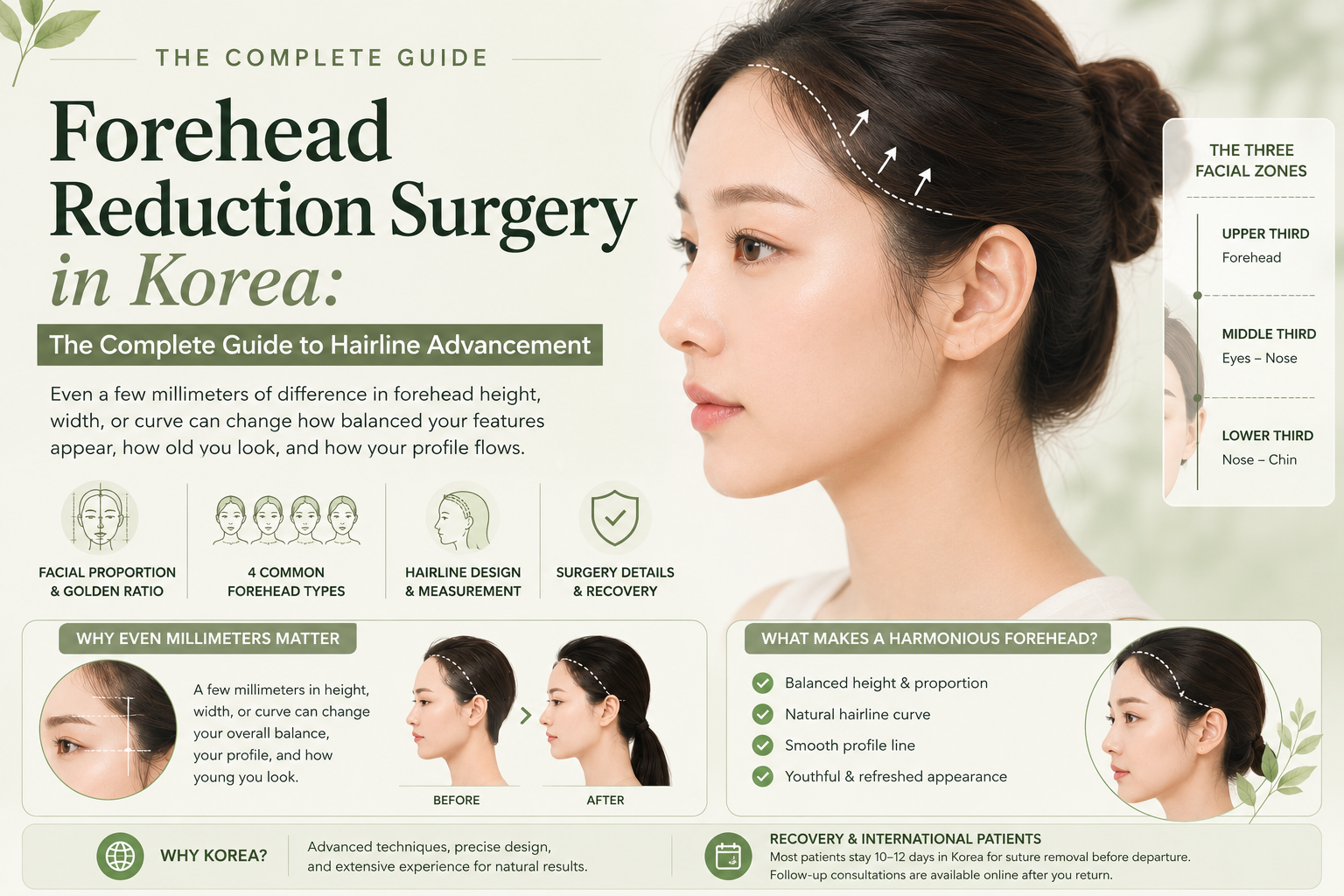
You've edited photos, tried different hairstyles, maybe even started wearing bangs. But the feeling doesn't go away — something about the upper half of your face feels off.
Most people assume the answer is eyes or nose. But look again: the forehead occupies the entire upper third of the face. When that proportion is even slightly off, the whole face reads as older, longer, or heavier than it actually is.
Forehead reduction surgery — also called hairline advancement — addresses this directly. It's one of the most underrated procedures in facial aesthetics, and one of the most quietly transformative.
Why the Forehead Defines Your Entire Face
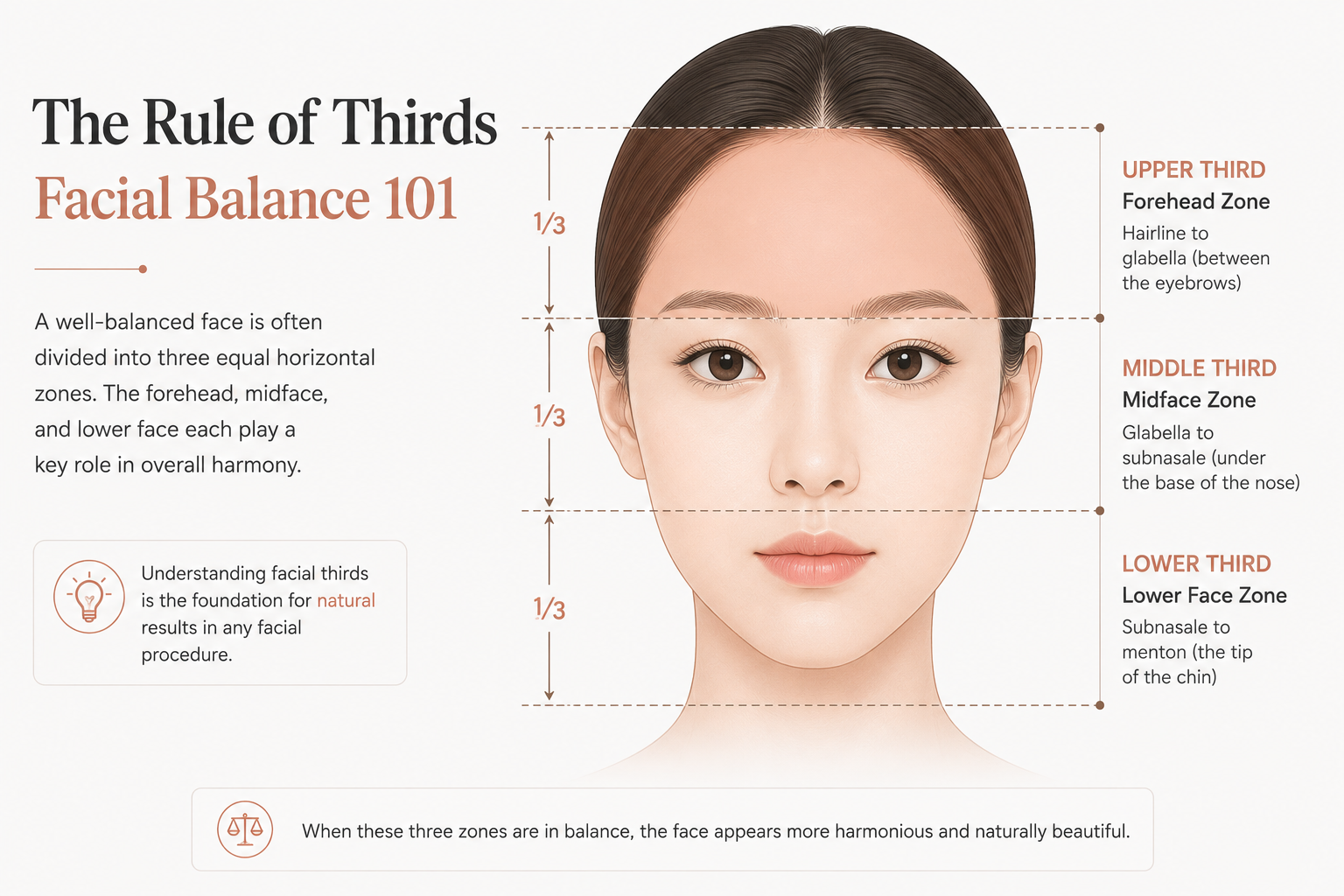
Aesthetic medicine organises the face around a fundamental framework: the Rule of Thirds.
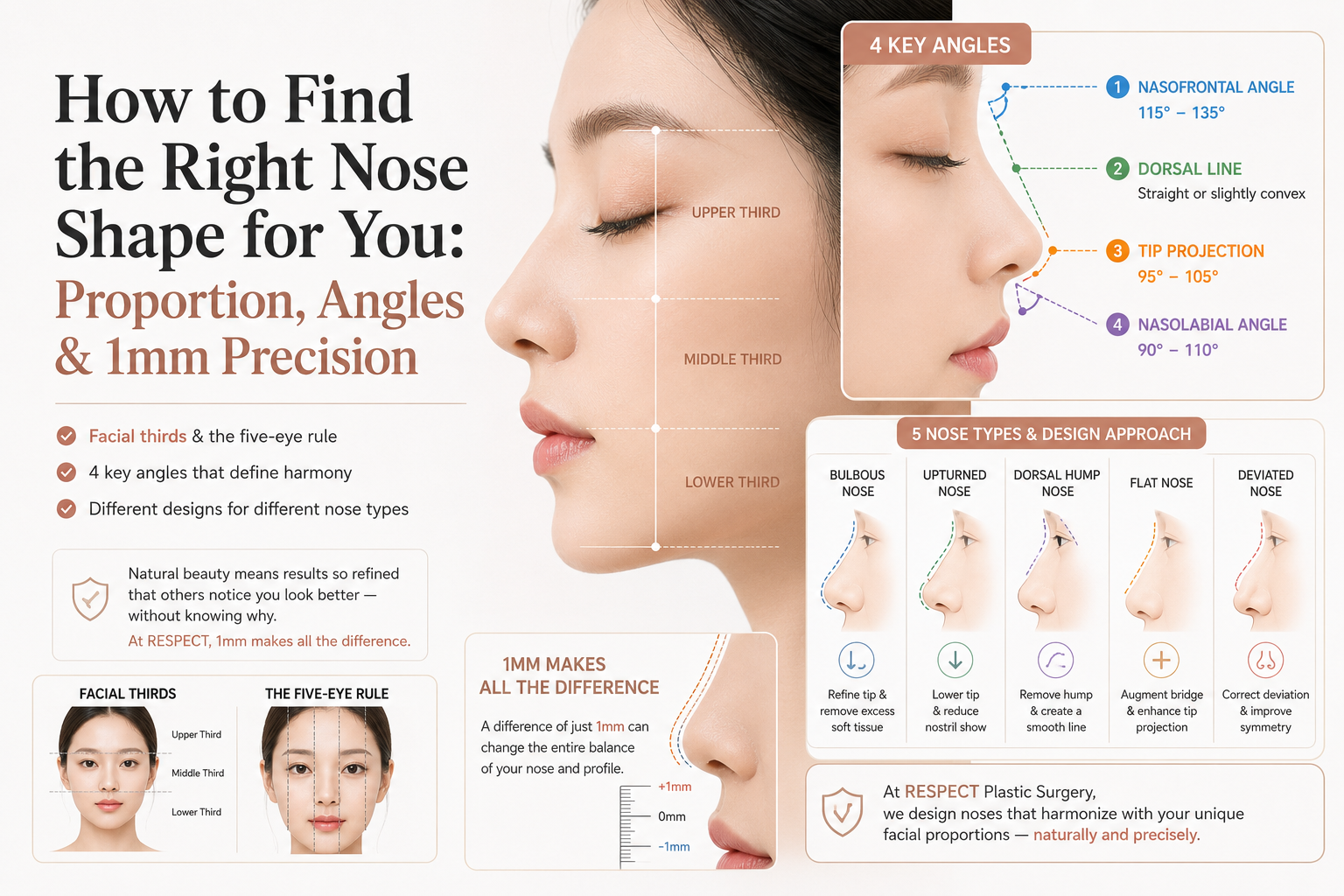
From hairline to chin, the face divides into three equal zones. The upper third runs from hairline to brow. The middle third from brow to nasal tip. The lower third from nasal tip to chin. The ideal ratio is roughly 1:1:1 — and for many Asian women, a slightly shorter lower third (1:1:0.8) creates a softer, more youthful appearance.
The forehead is the entire upper third.
When that section is too tall or too wide, the visual centre of gravity shifts upward. The face reads as longer, older, and less balanced. When forehead proportions are well-calibrated, features sit within a natural frame — and the entire face looks more refined without anything obvious changing.
A 7cm forehead can look completely different on two different faces. The number isn't the point. The proportion relative to your mid-face and lower face is.
Which Forehead Type Do You Have?
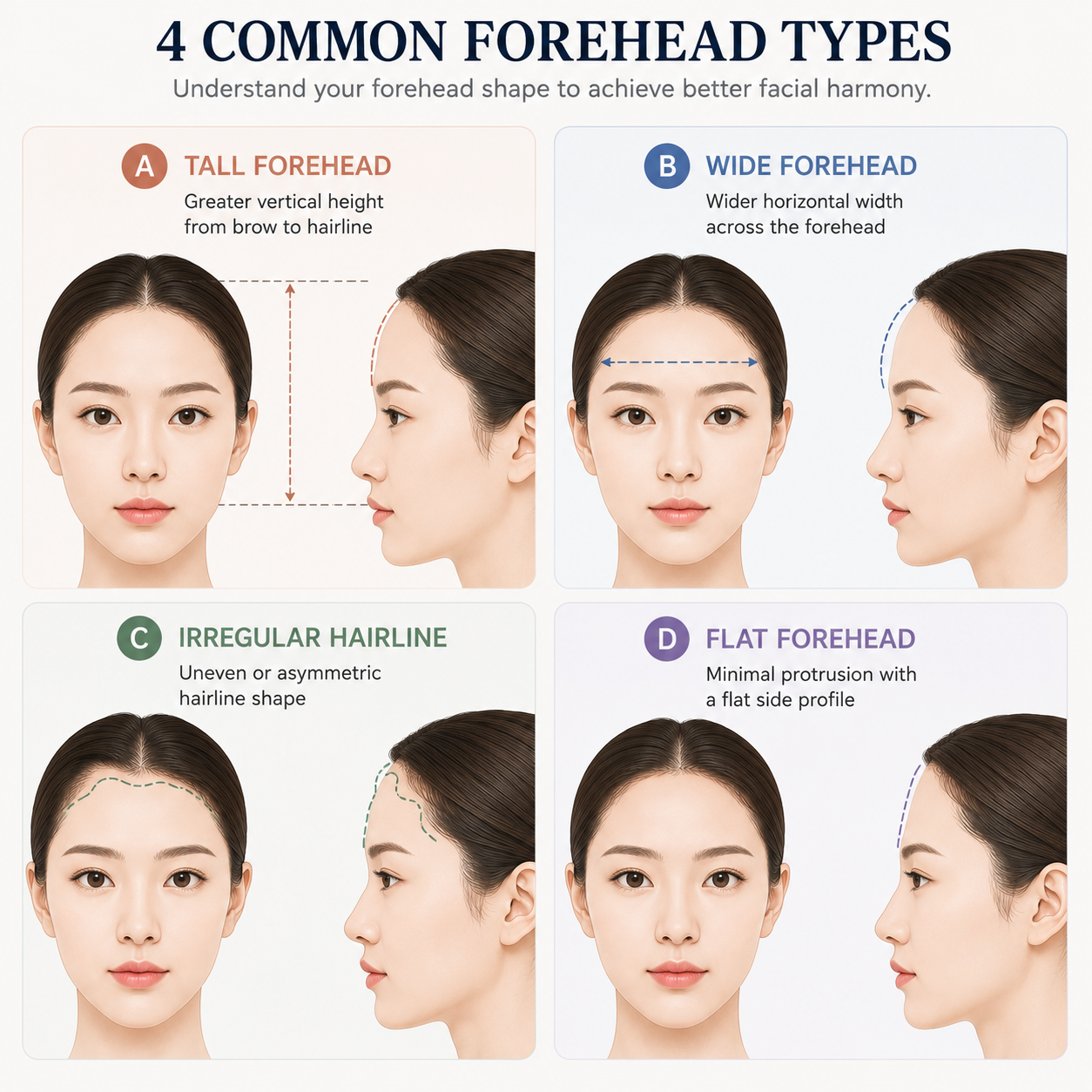
Four patterns account for the majority of forehead-related concerns.
Type A — Forehead too tall. The upper third is disproportionately large, making the face appear elongated and older. Quick self-test: place four fingers above your brow. If your hairline sits above your index finger, your forehead is on the tall side.
Type B — Forehead too wide. The forehead is noticeably wider than the cheekbones, making features appear less concentrated in the centre of the face. In photos, the upper half looks oversized.
Type C — Irregular hairline. A naturally receding M-shape, high temporal corners, or asymmetrical outline. Even when the forehead size is normal, an irregular hairline makes the overall face shape less soft and balanced.
Type D — Flat side profile. From the side, the forehead curve is too flat or has an abrupt step. This is often invisible from the front but significantly affects the side profile and 45-degree view.
Types A and C respond best to forehead reduction surgery. Type D can often be addressed in the same procedure. Type B may require a combination approach depending on the degree of width.
What "Ideal" Forehead Proportions Actually Look Like
There is no single correct forehead. But there are three measurements that define balance.
Height: Approximately one-third of total face length. Three to four finger-widths. For most women, 5.5–6.5cm. For men, slightly taller proportions read as more structured.
Width: Balanced with cheekbone width. The widest point of the forehead ideally sits just above the pupils. Neither noticeably wider than the cheekbones, nor narrower.
Curvature: Viewed from the side, the forehead carries a smooth arc from the brow bone to the hairline — not flat, not balloon-shaped. The highest point is typically at the frontal eminence, with a gentle transition to the hairline. This curve is what creates a youthful, smooth side profile.
The most important principle: the right forehead isn't a standard measurement. It's the proportion most harmonious with your specific features and face shape.
What Forehead Reduction Surgery Actually Does
Forehead reduction surgery repositions the hairline itself — not the hair follicles.
The procedure involves a precise incision made at the hairline. The scalp tissue is advanced forward, the hairline is lowered by approximately 1–2 centimetres, and the forehead area shrinks accordingly. The upper-third proportion improves immediately.
This is different from hair transplantation. Transplantation moves individual follicles; forehead reduction moves the entire scalp forward. The change is immediate and permanent.
The incision is placed using a wave-pattern technique designed to avoid damaging hair follicles. New hair grows through and around the scar line, and within several months the hairline appears as though it was always naturally positioned there.
The right candidate: Someone with a tall forehead, irregular hairline, or disproportionate upper third — with sufficient scalp elasticity and good general health.
Not a good fit for: Foreheads within normal proportion range, significant male-pattern baldness, or cases where hair volume rather than hairline position is the primary concern.
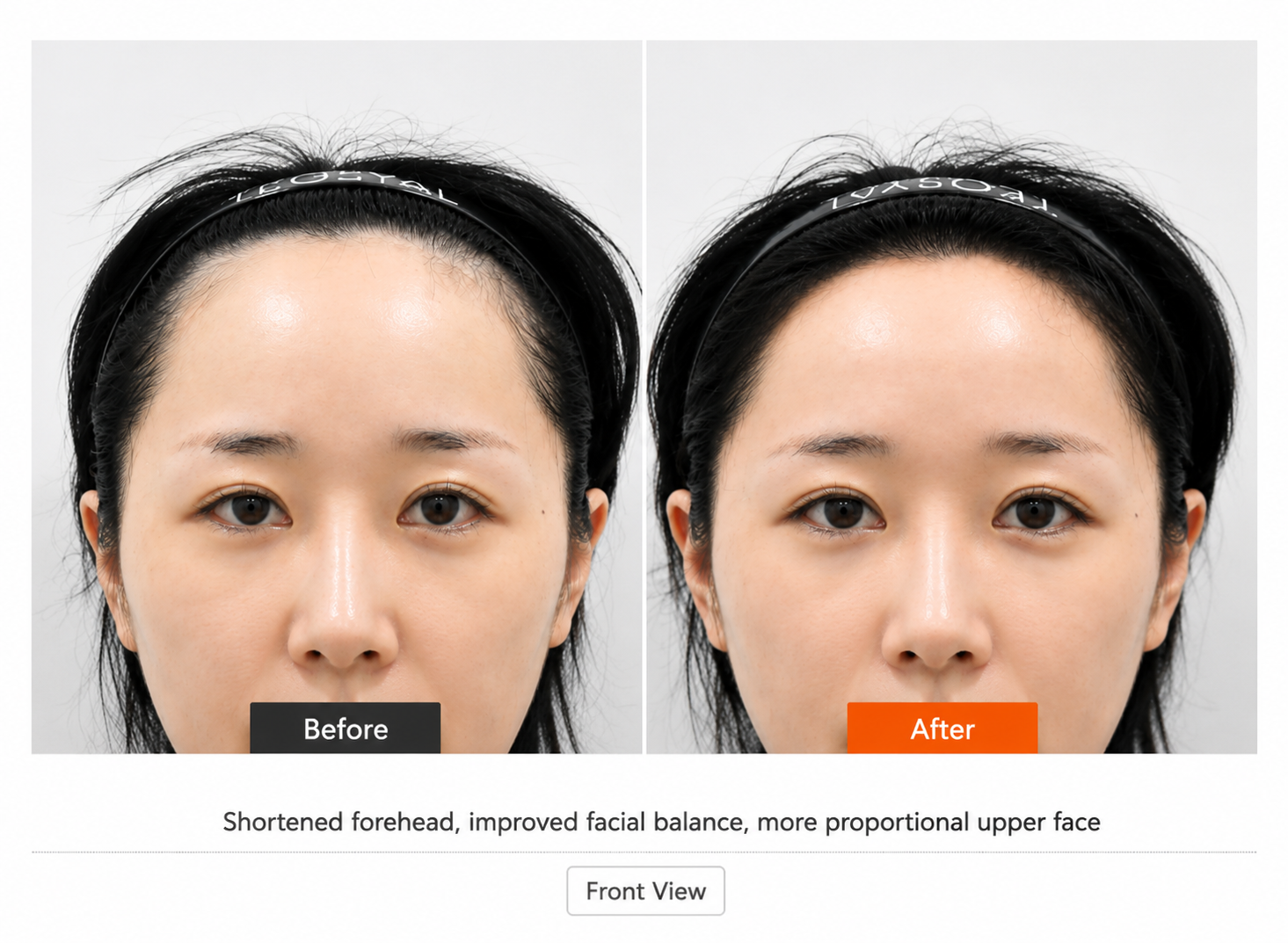
Why the Hairline Shape Matters as Much as the Height
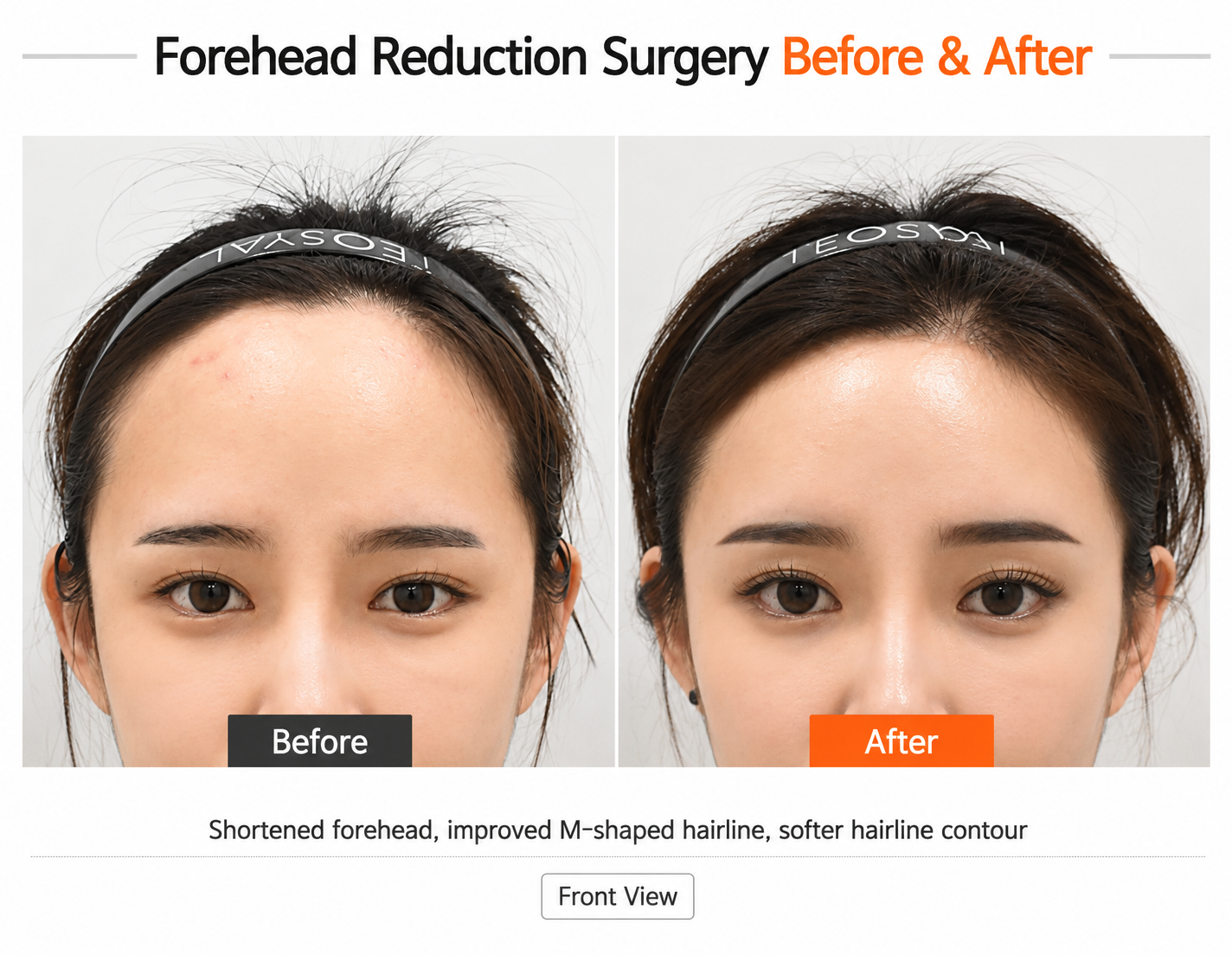
Most people focus on how much the hairline moves. The more important question is what shape it becomes.
A rounded oval hairline creates a softer, more feminine impression. A hairline with subtle lateral angles creates a more structured, defined look. Neither is universally correct — the right shape depends on the width of the forehead, the shape of the brow, and the overall geometry of the face.
At Respect, the hairline position and curvature are designed in increments of 1mm before surgery. Not because surgeons are being obsessive — but because at this scale of the face, 1mm genuinely changes the impression.
A hairline placed 2mm too low reads as artificial. A shape that's 1mm too rounded softens a face that would benefit from more structure. These differences are invisible in casual conversation. They're visible every time you look in a mirror.
Recovery: What to Expect Week by Week
Days 1–3: Swelling is most noticeable. Cold compresses help. Hair washing is restricted.
Day 7: Sutures are removed. Swelling has reduced significantly. Most patients return to light work around this point.
Weeks 2–4: Remaining swelling resolves. Hairline position looks close to the final result, though the scar line may still be pink.
Months 3–6: New hair grows through the scar line. The hairline becomes fully natural-appearing. Full stabilisation of the result occurs during this period.
International patients typically plan for 10–12 days in Seoul, covering suture removal before departure. Follow-up appointments are conducted online after return.
📸 Image recommendation: A recovery timeline graphic — horizontal timeline showing Day 1, Day 7, Month 1, Month 3, Month 6. For each stage: what it looks like (brief description or illustration), what the patient can do. Clean infographic format. This is consistently one of the highest-engagement image types for surgical procedure articles.
Forehead Reduction vs. Hair Transplant: Which Is Right?
This is one of the most common questions, and the answer depends entirely on the root cause.
| Forehead Reduction | Hair Transplant | |
|---|---|---|
| What it addresses | Forehead too tall, irregular hairline shape | Hair thinning, receding hairline with hair loss |
| How it works | Advances entire scalp forward | Moves individual follicles to new positions |
| Result timing | Immediate position change | 6–12 months for full growth |
| Best for | Type A and C forehead concerns | Hair density concerns, male-pattern hairline |
| Permanence | Permanent | Permanent (where follicles take) |
For patients with both a tall forehead and low hair density at the temples, a combined approach is sometimes recommended. This is assessed case by case.
Frequently Asked Questions
Q. How much does forehead reduction surgery cost in Korea?
A. Forehead reduction at reputable Gangnam clinics typically ranges from USD $3,000–$5,500, depending on the degree of advancement and complexity of the hairline design. This is generally 40–60% less than equivalent procedures in the US.
Q. How much can the hairline actually be lowered?
A. Most patients achieve 1–2cm of advancement. The upper limit is determined by scalp elasticity — a pre-operative elasticity assessment is standard. Attempting to advance beyond what the scalp allows creates tension and affects healing.
Q. Will the scar be visible?
A. With an experienced surgeon using the wave-pattern incision technique, the scar becomes virtually undetectable once new hair grows through. The incision runs along the natural hairline contour, not across it. Most patients report that even they struggle to find the scar within a year.
Q. Can forehead reduction be combined with other procedures?
A. Yes, commonly with brow lift, double eyelid surgery, or fat grafting. Combination timing is planned carefully — not all procedures are safely performed simultaneously, and the sequence matters for healing.
Q. Is the result permanent?
A. Yes. The repositioned hairline remains stable long-term. Natural ageing of the scalp is the same as it would be without surgery — there is no accelerated hairline recession associated with the procedure.
Click here to schedule a consultation.
English consultations are available for international patients.
 Google Maps