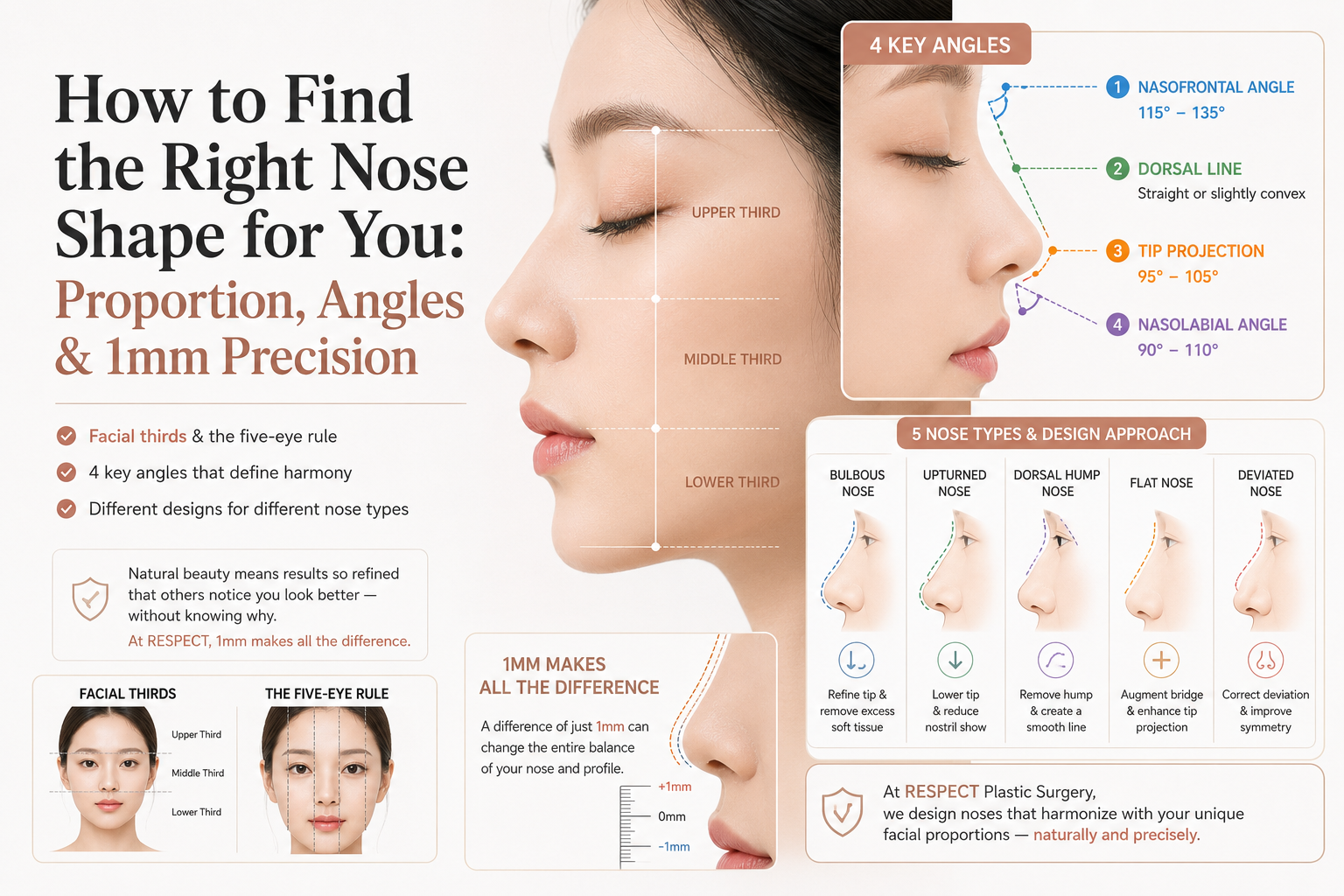
"The higher the nose, the better it looks."
You've probably heard this. But look closely at people widely considered attractive — their noses aren't necessarily tall. They're harmonious. The nose works with the face, not against it.
That distinction is exactly what separates great rhinoplasty from obvious rhinoplasty. And it's the reason Korean nose surgery has developed a reputation for results that are quietly transformative rather than visibly surgical.
This guide explains the proportional system behind nose design, the five most common nose concerns in Asian patients, and why 1mm of precision decides everything.
Why "Suited to Your Face" Matters More Than "Beautiful"
Most people arrive at a rhinoplasty consultation with a reference photo. It's a natural instinct. But a nose that looks perfect on one face can actively disrupt the balance of another.
A nose doesn't exist in isolation. It forms a complete proportional system with the height of the forehead, the distance between the eyes, the width of the cheekbones, and the length of the chin. Change one element without accounting for the others, and the result looks off — even if the nose itself is technically well-executed.
This is why truly successful rhinoplasty results don't make people say "your nose looks amazing." They make people say "you look refreshed" — without being able to identify what changed.
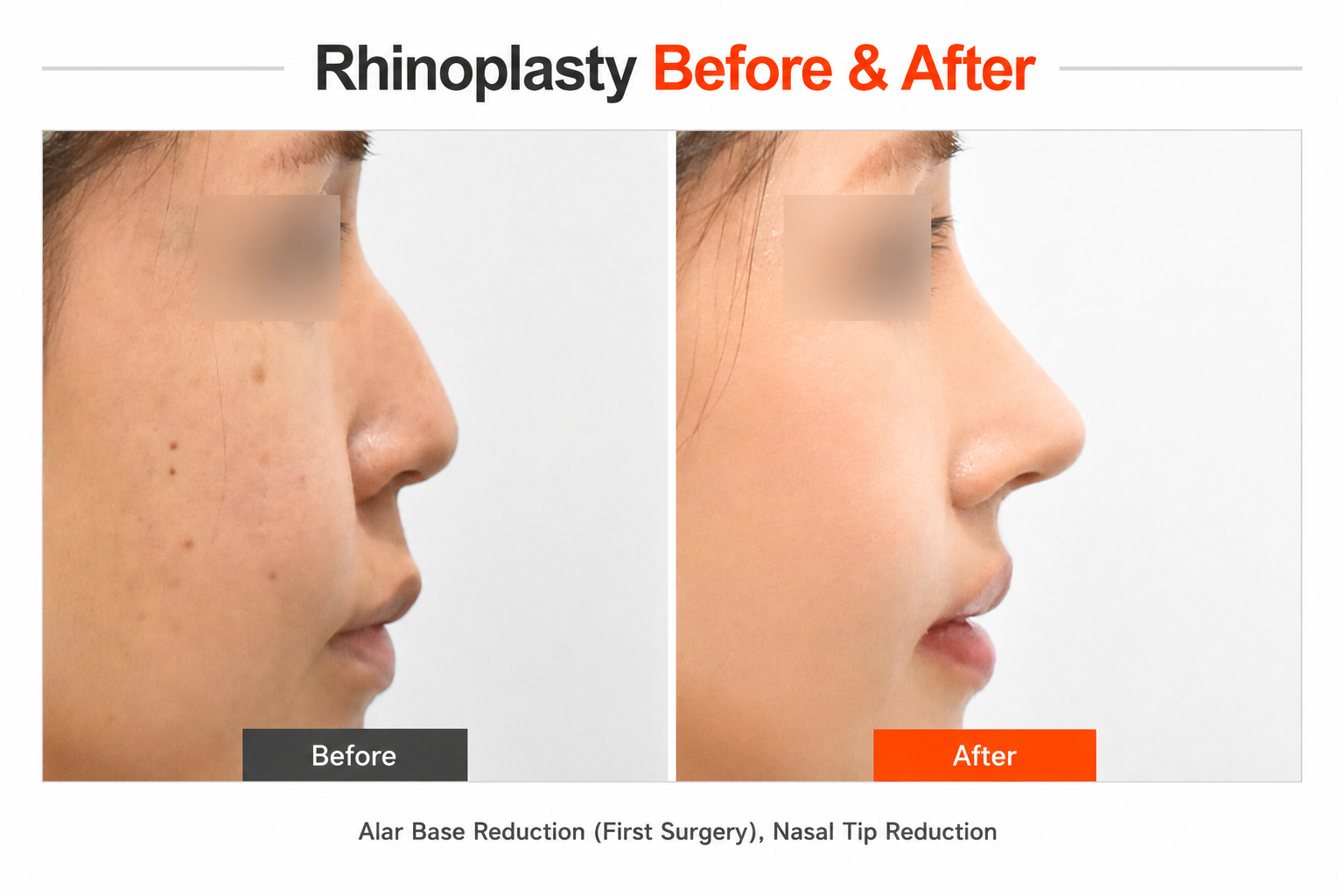
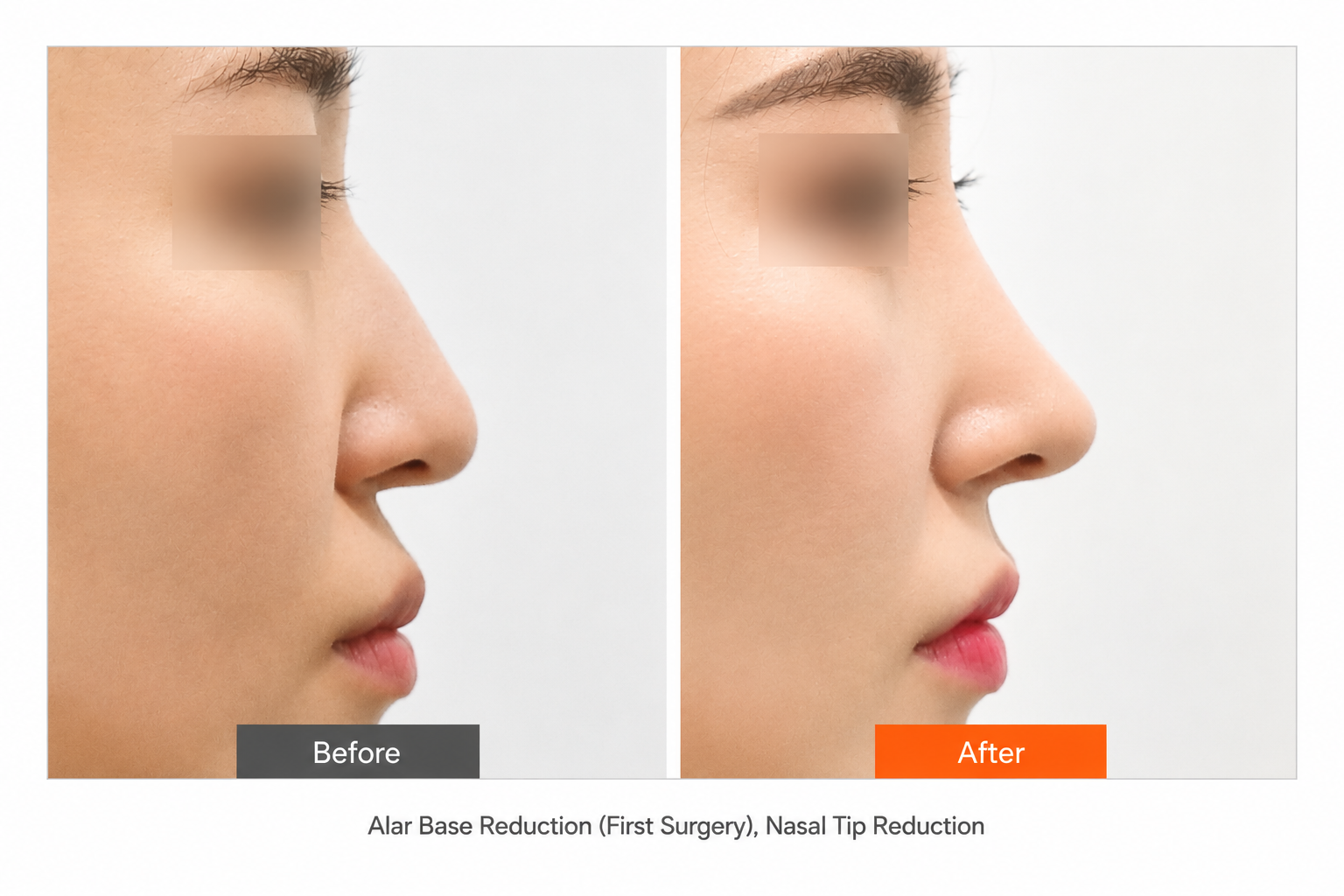
The Proportional Framework Korean Surgeons Use
Before any design decision is made, the face is mapped against four key proportion systems.
The Rule of Thirds
From the front, the face divides into three equal zones: hairline to brow, brow to nasal tip, nasal tip to chin. The nose length should equal the middle third. If your middle third is long, the nose reads as elongated; if short, it appears petite. This baseline determines whether surgery should lengthen or shorten.
The Rule of Fifths
The face width equals approximately five eye-widths. Ideal nostril width equals one eye-width — the distance between the inner corners of both eyes. Nostrils wider than this create visual heaviness; narrower creates an artificial, pinched look.
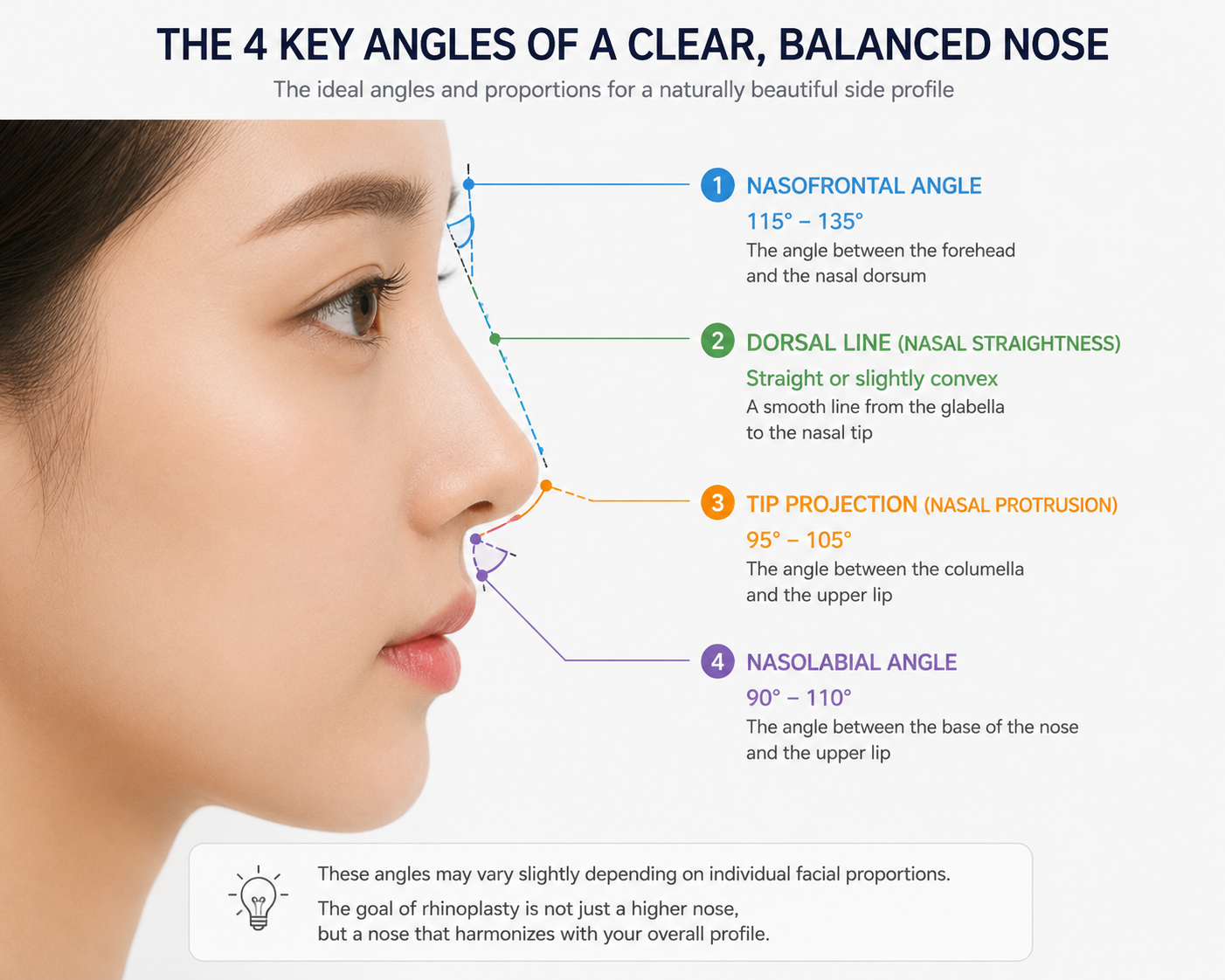
The Four Key Angles
Nasofrontal angle (120°–135°) — where the bridge meets the forehead. Too acute looks overly sculpted; too obtuse lacks definition.
Nasolabial angle (95°–110° for women, slightly less for men) — between the columella and upper lip. This determines whether the tip appears slightly upturned or drooping. One of the most misunderstood angles in rhinoplasty.
Tip projection — how far the tip extends relative to the bridge when viewed from the side. Over-projected reads as rigid; under-projected lacks refinement.
Dorsal line — straight, slightly concave, or slightly convex. Each produces a different aesthetic quality. Not every face suits a perfectly straight bridge.
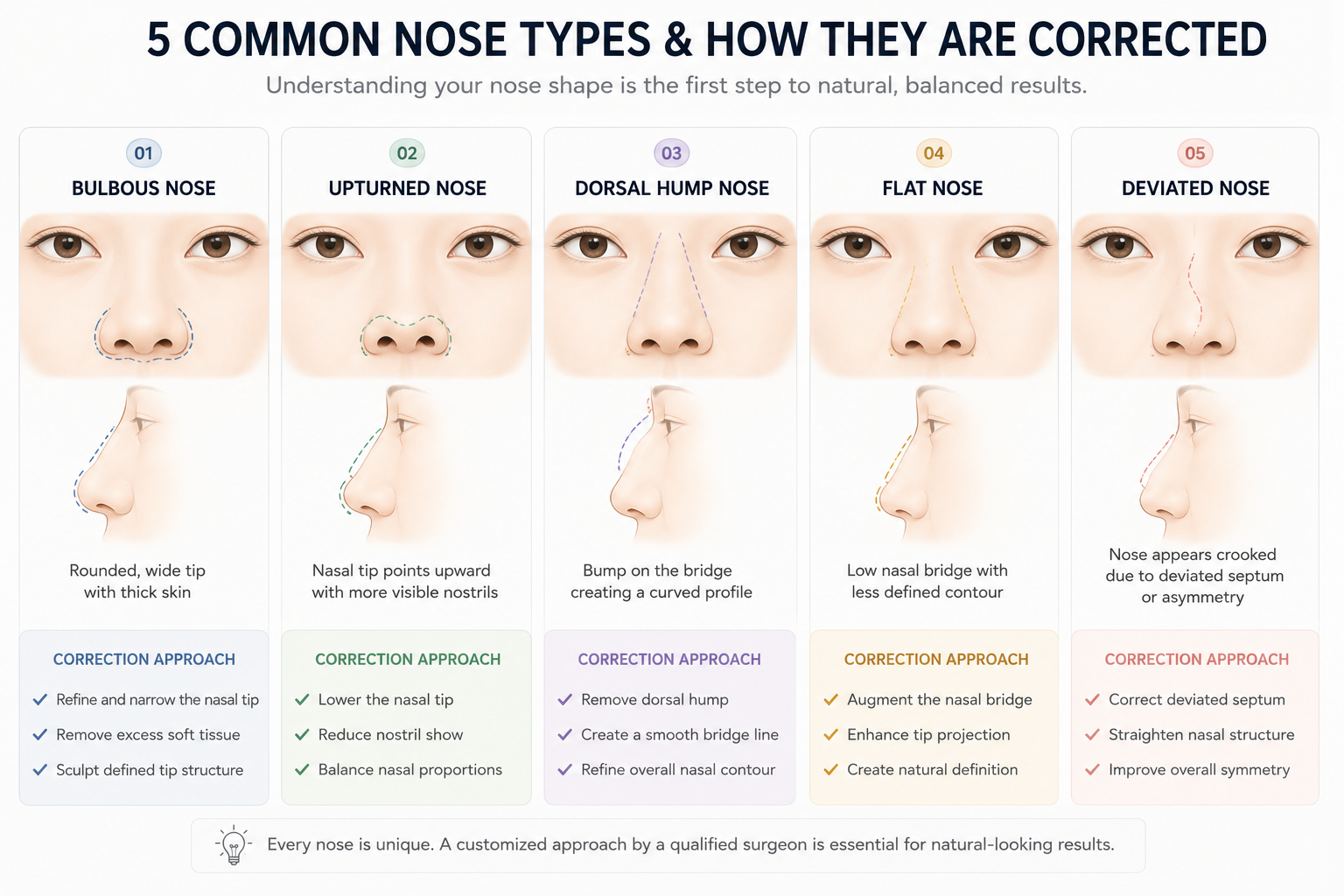
5 Common Nose Concerns in Asian Patients
Bulbous Nose — Round tip, wide nostrils
One of the most common concerns among Asian patients. The tip cartilage is relatively flat and subcutaneous tissue is thick, making the tip appear round and undefined.
The solution isn't "making it smaller" — it's rebuilding the structural support of the tip cartilage to create a clearly defined point. Volume reduction alone produces a flattened result, not a refined one.
Approach: Tip cartilage restructuring + support graft
Upturned Nose — Short bridge, visible nostrils
The core issue is insufficient nose length and an overly rotated tip angle. Addressing only the bridge height without extending the overall length often worsens the upturned appearance.
Approach: Septal extension graft + tip rotation adjustment
Dorsal Hump — Bridge bump, drooping tip
A prominent bony bump creates an arched profile from the side. The critical point: shaving the hump while ignoring the tip makes the nose appear even longer. Both must be addressed simultaneously.
Approach: Hump reduction + concurrent tip angle correction
Flat or Low Nose — Low radix, lacks dimension
Insufficient bridge height makes the entire face lack depth and three-dimensionality. But a radix that's placed too high looks artificial — like the nose was placed on the face rather than growing from it. Moderate elevation combined with tip refinement typically produces better results than chasing maximum height.
Approach: Conservative radix augmentation + tip refinement
Deviated Nose — Crooked bridge, asymmetry
Deviation of the nasal bone or septum affects not only appearance but often breathing function as well. Correction requires addressing both bony and cartilaginous structures simultaneously — treating only one produces temporary results.
Approach: Combined bone and cartilage correction
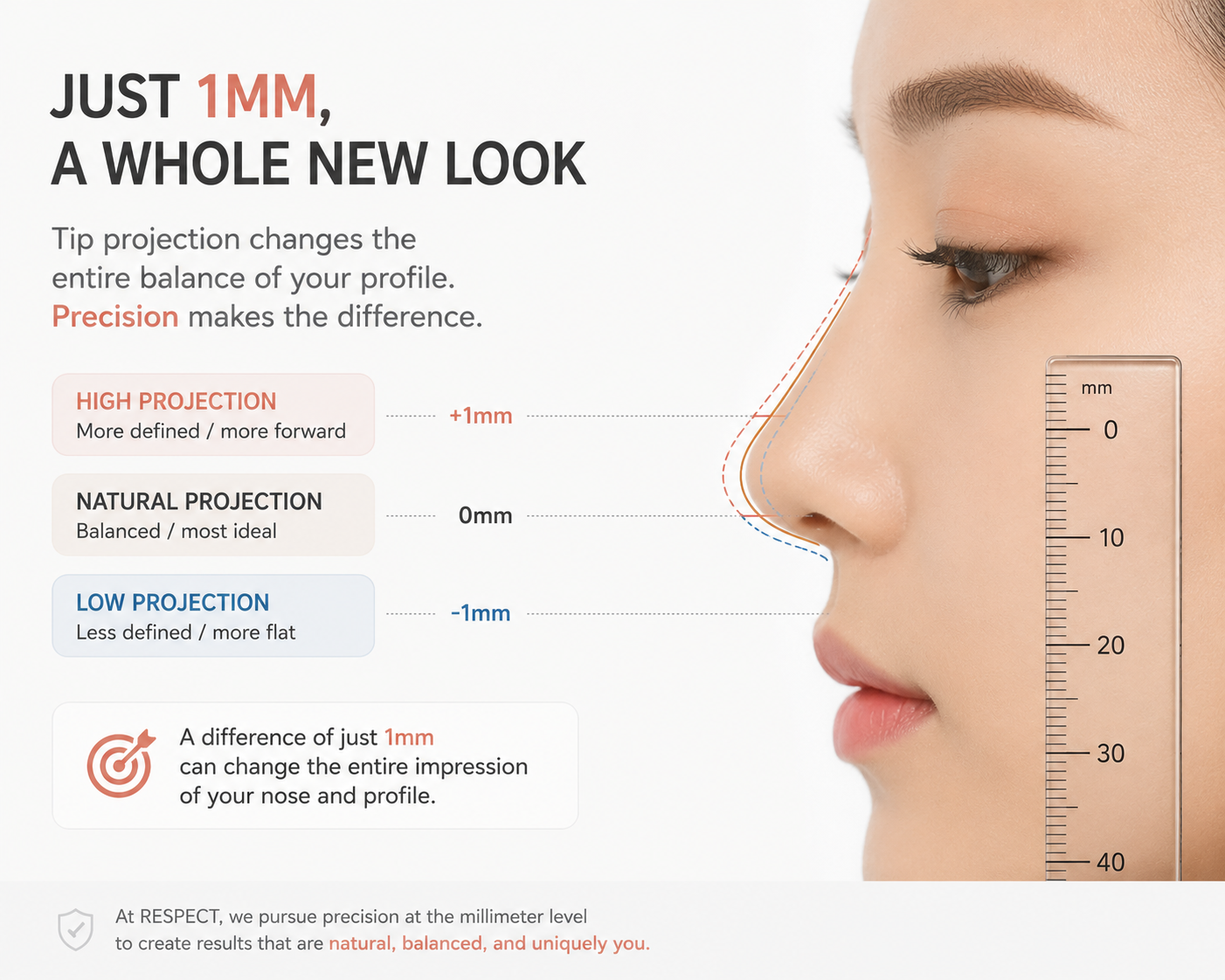
Why 1mm Decides Everything
If the radix starting point is 1mm higher, the nose reads as longer. If tip projection increases by 1mm, the side profile becomes more refined. If the nostrils narrow by 1mm, the frontal proportions shift entirely.
This isn't rhetoric. Subtle changes in nasal proportions measurably alter a person's perceived age and overall facial presence. But it also means every millimeter matters in both directions — too much looks unnatural; too little and the effect disappears.
The key to rhinoplasty isn't how far surgical technique can go. It's how precisely the surgeon can perceive and plan a 1mm difference.
How Korean Rhinoplasty Works at Respect
Pre-op: Proportion analysis and personalised design
Every patient undergoes a comprehensive facial proportion analysis before any surgical plan is made. Not just front and side views — 45-degree angles, upward and downward perspectives, a full 360° assessment. The consultation doesn't start with "what nose do you want?" It starts with: "Your face has these characteristics, and if we adjust this 1mm here, the overall impression shifts in this direction."
Surgery: Structural precision design
Based on each patient's nasal anatomy and facial proportions, the optimal material combination and surgical plan is selected. Bridge height, tip shape, nostril width, columella angle — each zone is designed independently and then coordinated as a whole system.
Post-op: Full-journey care for international patients
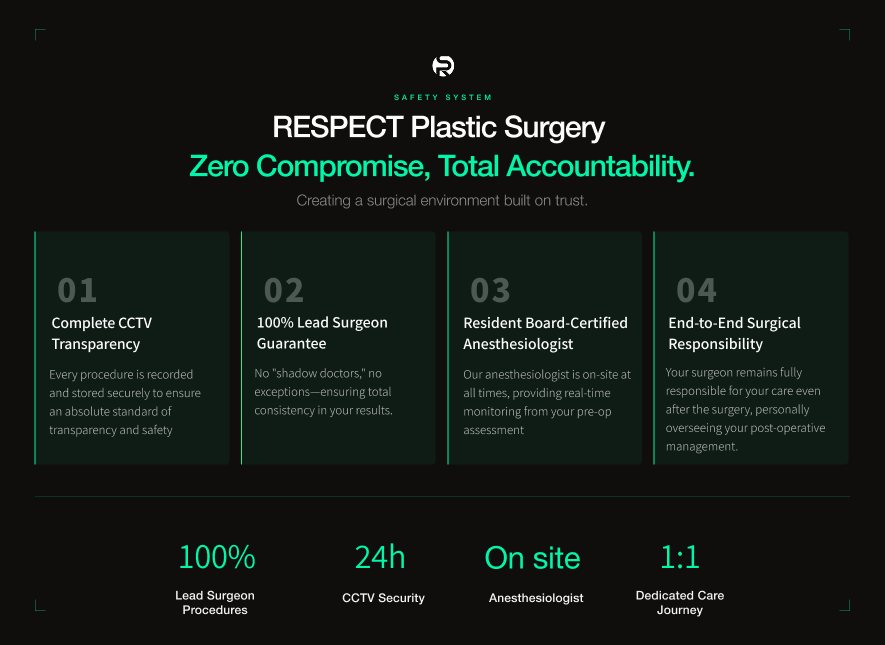
For patients traveling from the US, UK, Australia, or Southeast Asia, complete support is provided from arrival to recovery. Pre-op design, intra-op precision execution, post-op dedicated care — every phase has clear protocols and dedicated staff. Most rhinoplasty patients require 10–14 days in Seoul.
Three Questions to Ask Before Booking Rhinoplasty
What specifically do you want to change? Bridge height, tip shape, nostril width, or overall harmony? The more specific you can be, the more productive your consultation will be — and the more accurately a surgeon can assess whether what you want is achievable.
What are you afraid of? Most people's biggest fear isn't pain — it's "looking unnatural afterward." If that resonates, what you need isn't the most aggressive surgeon. It's the most restrained one.
How much trust are you willing to invest? Rhinoplasty is a deep collaboration between you and your surgeon. The result depends on someone willing to spend real time understanding your face — not applying a standard template.
Frequently Asked Questions
Q. How much does rhinoplasty cost in Korea?
A. Primary rhinoplasty at reputable Gangnam clinics typically ranges from USD $3,000–$7,000, depending on complexity. Revision rhinoplasty is significantly more complex and priced accordingly. Most international patients find Korean rhinoplasty 40–60% less expensive than equivalent procedures in the US or Australia.
Q. What is the recovery time for rhinoplasty in Korea?
A. The splint is typically removed at 7–10 days. Most visible swelling resolves within 3–4 weeks. Final result — including subtle tip refinement — takes 6–12 months to fully settle. Patients can return to normal activity within 2 weeks.
Q. Is Korean rhinoplasty different from Western rhinoplasty?
A. Yes, meaningfully so. Asian nasal anatomy differs from Western anatomy — thicker skin, flatter cartilage, lower radix — and requires different techniques. Korean surgeons operate on Asian anatomy at far higher volume than Western surgeons, producing a level of structural expertise that's genuinely difficult to replicate elsewhere.
Q. What materials are used in Korean rhinoplasty?
A. The most common approach combines a silicone or Gore-Tex implant for bridge augmentation with the patient's own cartilage (septal, ear, or rib) for tip work. Using the patient's own cartilage for the tip produces more natural movement and reduces long-term complication risk.
Q. Can I combine rhinoplasty with other procedures?
A. Yes. Rhinoplasty is frequently combined with double eyelid surgery, chin augmentation, or fat grafting. Combined procedures are carefully sequenced and planned, not simply stacked. Recovery timelines are adjusted accordingly.
Click here to schedule a consultation.
English consultations are available for international patients.
 Google Maps